What Are Peptides? vs. Amino Acid Chemistry: How the Two Foundational Concepts Differ
Peptides and amino acids are often discussed together, but they describe different levels of biological organization. Here's how the two foundational topics relate and differ.
Quick Answer
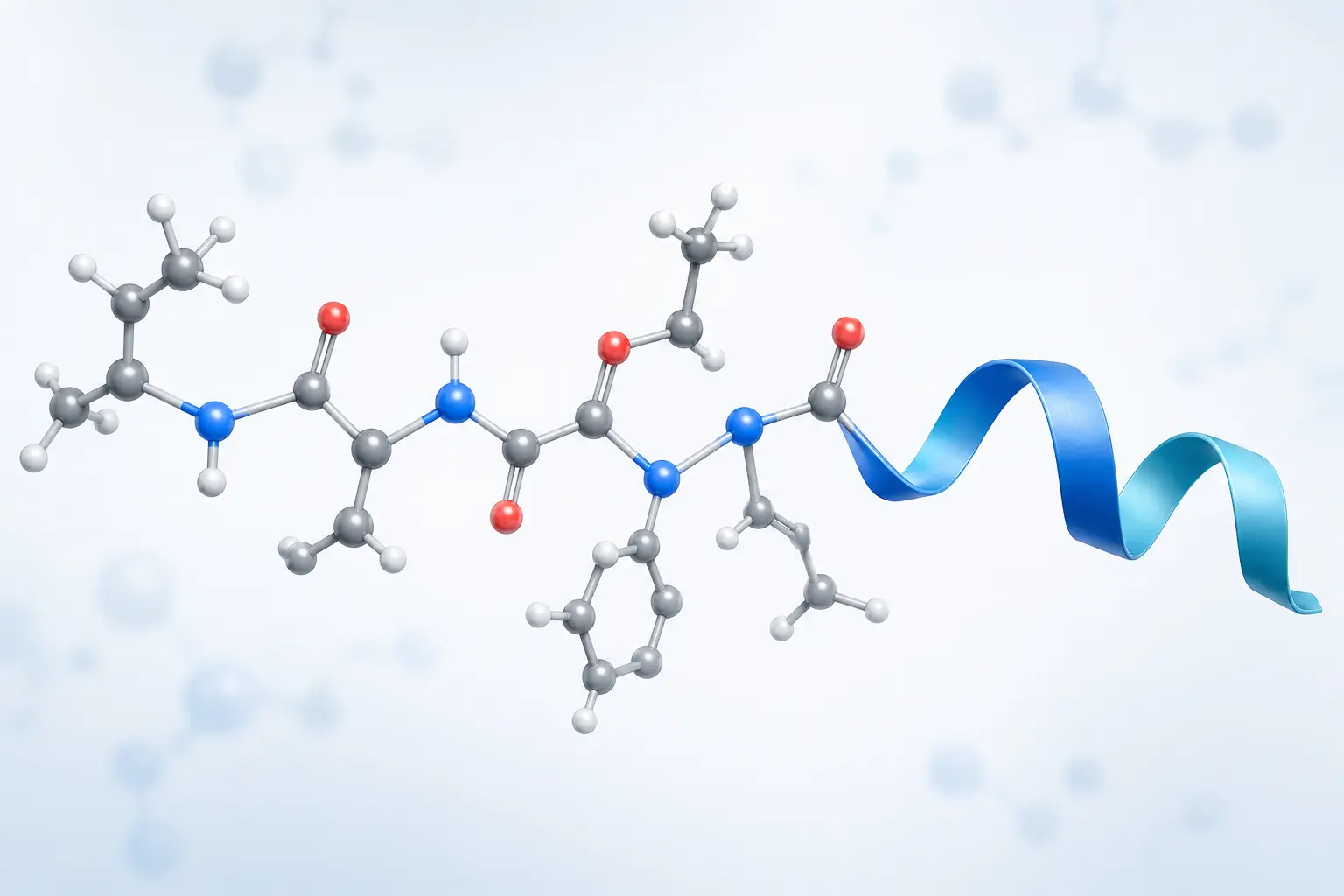
"What Are Peptides?" and "Amino Acid Chemistry" are not competing explanations of the same thing — they describe two different, connected levels of molecular organization. Amino acids are the individual monomer units; peptides are short chains of amino acids joined by peptide bonds. You cannot fully understand why a specific peptide behaves the way it does (its stability, charge, or receptor binding) without understanding the amino acid chemistry that composes it, which is why these two topics are best read together rather than as alternatives.
Key Differences
| What Are Peptides? | Amino Acid Chemistry | |
|---|---|---|
| Level of organization | Chain-level (2–50 linked residues) | Monomer-level (single building block) |
| Core question answered | How do peptides form, and why are they useful in research? | What determines a residue's chemical behavior? |
| Key concepts | Peptide bonds, chain length classification, in vitro vs. in vivo | Side chain classes, ionization, chirality, non-standard residues |
| Typical use in research | Explains a compound's overall category and general behavior | Explains why a specific sequence change alters stability or binding |
Mechanisms: Where Chain-Level and Residue-Level Explanations Meet
A peptide bond forms when the carboxyl group of one amino acid reacts with the amino group of another in a condensation reaction, releasing a water molecule. [] This is a chain-level event — but whether that bond is easily broken by a protease, whether the resulting peptide carries a net positive or negative charge, and whether it can access a target receptor's binding pocket are all questions that can only be answered by looking at which amino acids occupy each position in the sequence.
This is the central relationship between the two topics: "What Are Peptides?" describes the chain as a category (dipeptides, oligopeptides, polypeptides), while "Amino Acid Chemistry" describes the residue-level properties — nonpolar, aromatic, polar, charged side chains, plus special cases like proline's ring structure — that determine how any specific chain in that category will actually behave. []
Evidence and Scope Comparison
Both articles are foundational, educational content rather than compound-specific research reviews, so "evidence level" in the clinical-trial sense does not apply to either in the way it would to a specific research peptide. Instead, the relevant comparison is scope and depth: "What Are Peptides?" surveys peptide classification, synthesis strategy, and stability at a chain-wide level, citing general peptide therapeutics literature. [][] "Amino Acid Chemistry" goes one level deeper, covering side-chain classification, ionization behavior, and non-standard amino acids (D-amino acids, Aib, Nle, 2-Nal) used in synthetic peptide design.
Human Trial Relevance
Neither article is itself compound-specific research, so neither presents human trial data directly. Their relevance to human trial literature is indirect: understanding amino acid chemistry (for example, why a D-amino acid substitution resists degradation, or why a Pro-Gly-Pro extension alters conformation) provides the vocabulary needed to interpret the methods sections of actual peptide research studies, including the trial and mechanism data presented in compound-specific articles across this site.
Safety and Research Considerations
Because both articles are foundational chemistry and biology content rather than reviews of a specific research compound, neither carries compound-specific safety findings. The practical safety-adjacent consideration that connects them is stability and degradation: amino acid-level properties (protease cleavage sites, oxidation-prone residues like methionine and cysteine) directly determine how quickly a peptide degrades in a research setting, which in turn affects study design and interpretation of any observed effect. []
Regulatory Status
Neither topic describes a regulated product. "What Are Peptides?" and "Amino Acid Chemistry" are educational overviews of chemistry and classification, not reviews of an FDA-regulated substance, and neither has an associated approval or compounding-eligibility status. Regulatory status only becomes relevant once a specific synthetic peptide sequence is discussed — see individual compound articles such as BPC-157 or the FDA PCAC review overview for that layer of information.
Research Limitations
The main limitation in comparing these two articles is that they are not truly comparable in the way two competing research compounds are — they operate at different levels of description and are meant to be read as complementary background, not alternatives. Readers looking for compound-specific conclusions should treat both articles as prerequisite context rather than as answers in themselves, and should move on to compound-specific literature (such as the BPC-157 or Selank reviews on this site) once the foundational vocabulary from both pieces is clear.
Frequently Asked Questions
Should I read "What Are Peptides?" or "Amino Acid Chemistry" first?
Most readers benefit from starting with "What Are Peptides?" for the chain-level overview, then reading "Amino Acid Chemistry" for the residue-level detail that explains why specific peptides behave differently from one another.
Does amino acid chemistry explain peptide side effects?
Not directly. Amino acid chemistry explains structural properties like charge, stability, and receptor-binding potential. Actual physiological effects reported in research studies depend on many additional factors beyond sequence chemistry, including dose, administration route, and the specific biological system studied.
Are D-amino acids covered in "What Are Peptides?"
Only briefly. The detailed discussion of D-amino acids, Aib, and other non-standard residues used in synthetic peptide design is in "Amino Acid Chemistry," which focuses specifically on residue-level chemistry.
References
- 1.Craik DJ, Fairlie DP, Liras S, Price D. “The future of peptide-based drugs.” Chemical Biology & Drug Design. 2013;81(1):136-147. doi:10.1111/cbdd.12055 [PubMed]
- 2.Fosgerau K, Hoffmann T. “Peptide therapeutics: current status and future directions.” Drug Discovery Today. 2015;20(1):122-128. doi:10.1016/j.drudis.2014.10.003 [PubMed]
- 3.Vlieghe P, Lisowski V, Martinez J, Khrestchatisky M. “Synthetic therapeutic peptides: science and market.” Drug Discovery Today. 2010;15(1-2):40-56. doi:10.1016/j.drudis.2009.10.009 [PubMed]