What Are Peptides? A Research-Backed Introduction
A foundational overview of peptides: what they are, how they work at the molecular level, and why they matter to researchers studying human physiology.
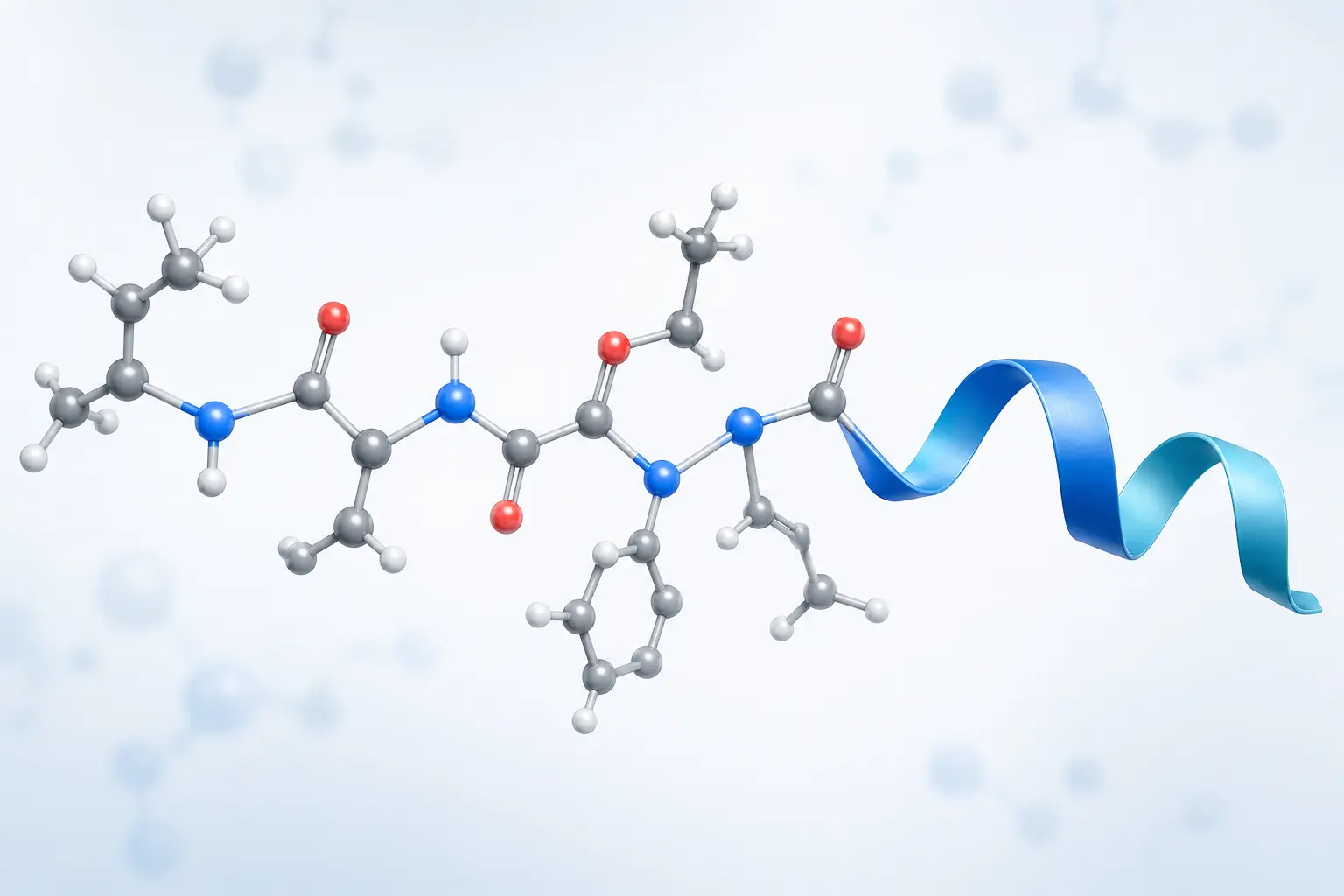
Peptides are short chains of amino acids linked by peptide bonds. They sit between individual amino acids (the smallest units) and full proteins (which are typically longer chains that fold into complex three-dimensional structures). The distinction matters: a peptide with 2–50 amino acids behaves very differently from a 300-amino-acid protein.
How Peptide Bonds Form
When two amino acids link together, the carboxyl group (–COOH) of one reacts with the amino group (–NH₂) of another. This reaction releases a water molecule — a process called condensation or dehydration synthesis. The resulting covalent bond between the carbon of one amino acid and the nitrogen of the next is the peptide bond.
The sequence of amino acids in a peptide is called its primary structure. Even small changes in this sequence can dramatically alter how the peptide behaves, which is why research studies pay close attention to the exact amino acid composition.
Why Peptides Are Biologically Interesting
Unlike large proteins, most peptides are small enough to interact directly with cell surface receptors. This makes them compelling subjects for research into signaling pathways. Many naturally occurring peptides function as:
- Hormones (e.g., insulin, which is a peptide hormone)
- Neurotransmitters (e.g., enkephalins)
- Antimicrobial agents (found in the skin of many amphibians)
- Growth factors (fragments that stimulate specific cellular responses)
Stability and Bioavailability in Research Contexts
One of the challenges researchers encounter with peptides is stability. Most peptides are susceptible to degradation by enzymes called peptidases or proteases, which cleave peptide bonds. This degradation happens quickly in biological fluids, which affects how they are administered in research settings.
Strategies researchers use to extend peptide stability include:
- Chemical modification of the backbone or terminus
- Cyclization — forming a ring structure that is harder to cleave
- D-amino acid substitution — using mirror-image amino acids that many peptidases cannot recognize
Classification by Length
Researchers typically classify peptides by their amino acid count:
| Name | Amino Acids | Example |
|---|---|---|
| Dipeptide | 2 | Carnosine |
| Tripeptide | 3 | Glutathione |
| Oligopeptide | 4–20 | Oxytocin (9 AA) |
| Polypeptide | 21–50+ | Insulin B chain (30 AA) |
When chains extend beyond ~50 amino acids and adopt stable three-dimensional folds, they are typically considered proteins.
Related Reading
If you are reading a peptide paper or evaluating a compound claim, these companion guides are useful next steps:
- Amino Acid Chemistry: The Building Blocks of Peptides for the molecular basis of peptide structure
- How Peptides Are Synthesized: Solid-Phase Peptide Synthesis for practical manufacturing context
- Peptide Purity Testing: HPLC and Mass Spectrometry Explained for analytical quality control
- Reconstituting and Storing Research Peptides: A Practical Guide for handling and stability considerations
- How to Read a Peptide Research Study: A Practical Guide for a framework for evaluating study quality
- Collagen Peptides: What the Research Examines for one of the better-developed human evidence examples in the skin and longevity literature
A Note on Research Standards
Research into synthetic peptides must distinguish carefully between in vitro (test tube / cell culture) findings and in vivo (animal or human) results. A peptide that shows compelling activity in cell culture may not survive long enough in a living organism to reach its target tissue. Every claim about peptide activity should be evaluated in the context of the study design that produced it.
Peptides vs. Proteins: Why the Distinction Matters in Research
The boundary between a peptide and a protein is not sharp — it is a convention of size and structural complexity. Most biochemists treat sequences up to approximately 50 amino acids as peptides and larger chains as proteins, though some use 100 amino acids as the threshold.
The distinction matters practically because peptides and proteins behave very differently:
Synthesis: Most research peptides are produced by chemical synthesis (solid-phase peptide synthesis), which becomes impractical for long sequences. Proteins are typically expressed in biological systems (bacterial, yeast, or mammalian cells) that can fold the chain into its correct three-dimensional structure.
Folding: Proteins adopt complex three-dimensional folds that are central to their function — enzymes, antibodies, and structural proteins are defined by their shape. Most short peptides do not fold into stable structures in isolation, though some (like cyclic peptides) can adopt constrained conformations.
Degradation: Peptides are generally more susceptible to rapid degradation by proteases and peptidases than folded proteins, which may bury cleavage sites in their interior.
Receptor interactions: Many peptide hormones (insulin, GLP-1, ghrelin) work by binding to receptors on cell surfaces. Their relatively small size allows direct access to receptor binding pockets. Large proteins typically cannot engage membrane receptors in the same way.
These properties explain both why research peptides are interesting (small, synthesizable, receptor-active) and why they face the challenges researchers study (rapid degradation, poor oral bioavailability, immunogenicity at scale).
How Synthetic Research Peptides Differ from Natural Peptides
The peptides discussed in research contexts are almost always synthetic — manufactured rather than extracted from natural sources. Synthesis allows researchers to:
- Test specific sequences not found in nature
- Incorporate non-natural amino acids (D-amino acids, unusual side chains) that alter stability or receptor binding
- Modify termini to improve resistance to enzymatic degradation
- Produce defined, pure material in quantities suitable for controlled studies
Natural peptides and their synthetic counterparts may have very different pharmacokinetic profiles even when their sequences are identical. A synthetic peptide administered in a research context enters a complex biological environment — exposed to enzymes, binding proteins, and tissues it was not designed to encounter in isolation.
Why Peptide Research Has Grown
Several converging factors have made peptide research more active since the 1990s:
Improved synthesis technology: Solid-phase peptide synthesis became more efficient and accessible, reducing the cost of producing research-grade peptides.
Better analytical tools: HPLC and mass spectrometry allow researchers to verify peptide identity and purity with high confidence, improving data quality.
Validated targets: Decades of receptor pharmacology identified GPCRs and other targets amenable to peptide ligands — providing clear mechanistic hypotheses to test.
Drug approvals: Several peptide-derived drugs (insulin analogs, GLP-1 receptor agonists, HIV protease inhibitors) demonstrated that peptide pharmacology could translate from bench to clinic, justifying continued investment.
Researchers approaching this literature should be aware that the range of evidence quality across different compounds is enormous — from drugs that have completed Phase III trials to research compounds with only a handful of animal studies. See our guide to evaluating peptide research claims for a framework that applies across this spectrum.
References
- 1.Craik DJ, Fairlie DP, Liras S, Price D. “The future of peptide-based drugs.” Chemical Biology & Drug Design. 2013;81(1):136-147. doi:10.1111/cbdd.12055 [PubMed]
- 2.Fosgerau K, Hoffmann T. “Peptide therapeutics: current status and future directions.” Drug Discovery Today. 2015;20(1):122-128. doi:10.1016/j.drudis.2014.10.003 [PubMed]