TB-500 and Thymosin Beta-4: What the Research Examines
TB-500 and Thymosin Beta-4 research: structural relationship, cellular mechanisms including actin regulation and wound healing, and state of clinical evidence.
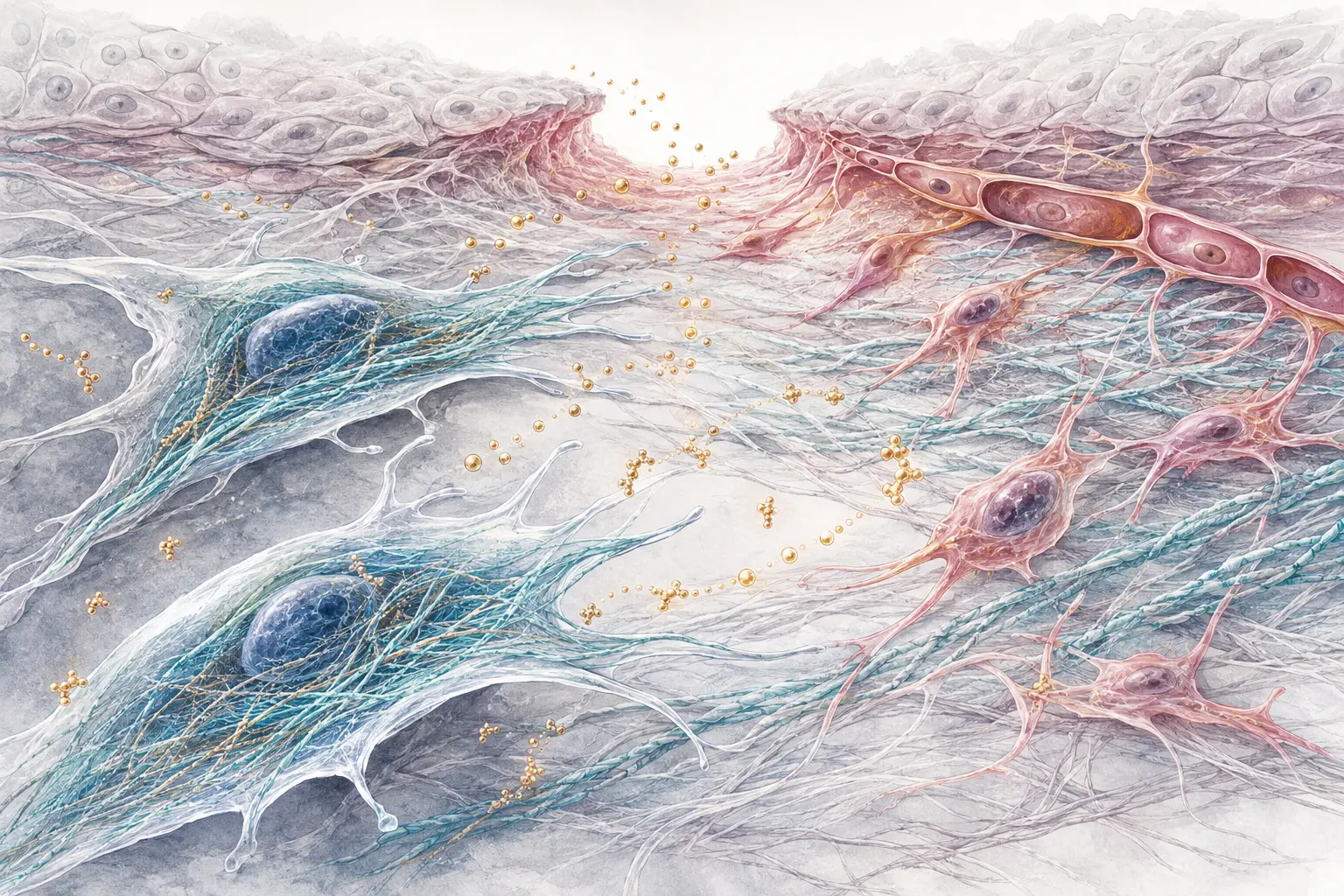
Thymosin Beta-4 (Tβ4) is a naturally occurring 43-amino-acid peptide found in high concentrations in many cell types and tissues. It was originally isolated from thymic tissue, though researchers have since identified it throughout the body, with particularly high concentrations in platelets, macrophages, and wound fluid.
TB-500 is often discussed alongside BPC-157, another peptide that researchers have studied in wound healing and tissue models. Both are pre-clinical compounds without published human RCT data.
The name TB-500 has been used inconsistently. In FDA's 2026 chemistry review, TB-500 free base is described as the N-acetylated seven-amino-acid fragment Ac-Leu-Lys-Lys-Thr-Glu-Thr-Gln-OH (Ac-LKKTETQ), corresponding to residues 17–23 of Tβ4. The acetyl group and the exact chemical form matter when comparing a tested material with the parent 43-amino-acid peptide. [4]
The Actin Connection
Much of the research interest in Tβ4 and TB-500 centers on the peptide's relationship with actin dynamics. Tβ4 is one of the most abundant actin-sequestering peptides in eukaryotic cells.
Actin exists in two forms: globular (G-actin, the monomer) and filamentous (F-actin, the polymerized form). The dynamic interconversion between these forms — actin polymerization and depolymerization — underlies fundamental cellular processes including cell migration, shape change, and division.
Tβ4 binds G-actin with high affinity, maintaining a cellular pool of unpolymerized actin available for rapid response to signals requiring cytoskeletal reorganization. Researchers studying cell migration, wound healing models, and angiogenesis have been particularly interested in this mechanism because all three processes require coordinated actin dynamics.
What Cell and Animal Studies Have Examined
Research on Tβ4 and TB-500 in pre-clinical models has investigated several potential activities:
Angiogenesis models: Some in vitro and animal studies have reported that Tβ4 may promote the migration of endothelial cells and the formation of new blood vessel networks. Researchers have observed upregulation of certain matrix metalloproteinases (MMPs) in treated cultures, though the physiological significance of these in vitro observations requires careful interpretation.
Cardiac tissue research: A notable line of research has examined Tβ4 in cardiac injury models. Several animal studies, primarily in rodents, have reported observations suggesting Tβ4 may be involved in cardiac progenitor cell migration following ischemic injury. Researchers at Johns Hopkins and other institutions published work in this area in the 2000s and 2010s. These findings generated interest in potential applications, though translation to human clinical benefit has not been established.
Wound healing models: Animal studies using topical and systemic administration have examined whether Tβ4 may accelerate wound closure metrics. The proposed mechanism involves both cell migration promotion and modulation of inflammatory markers.
Anti-inflammatory observations: Some studies have examined Tβ4's relationship with inflammatory signaling. One proposed mechanism involves the peptide's interaction with NF-κB pathways, though this research is largely pre-clinical.
TB-500 vs. Tβ4: Why the Fragment Is Used in Research
The full 43-amino-acid Tβ4 sequence is more costly to synthesize at scale than shorter fragments. Researchers identified the LKKTETQ sequence (amino acids 17–23 of Tβ4) as potentially retaining the actin-binding activity central to proposed mechanisms, making it a practical research compound.
It is important for researchers to note that fragment-based activity does not guarantee equivalent activity to the parent peptide. The full Tβ4 molecule may have binding partners or structural features not replicated by the fragment alone.
Clinical Research Status
As of this writing, Tβ4-derived compounds have entered human clinical trials in limited contexts:
- RegeneRx Biopharmaceuticals has investigated Tβ4 for corneal wound healing and dry eye
- Some Phase I/II trials examined cardiac applications following earlier animal data
These trials represent early-stage evaluation. The fact that a compound reaches human trials does not confirm efficacy; most compounds that enter trials do not achieve regulatory approval.
TB-500 as a specific fragment has not been the subject of published human clinical trials as of this writing.
July 2026 FDA PCAC Outcome
FDA evaluated TB-500 free base and TB-500 acetate for possible inclusion on the Section 503A Bulks List for wound healing. The agency distinguished these substances from full-length thymosin beta-4 and emphasized that evidence about the parent peptide cannot automatically be attributed to the seven-amino-acid fragment. [4]
FDA reported no identified human administration data for the reviewed TB-500 substances and highlighted gaps in identity, impurities, aggregation, microbial controls, immunogenicity, historical compounding use, and clinical effectiveness. FDA staff concluded that the evidence weighed against placing either form on the list. [4]
On July 23, 2026, PCAC voted 8–6, with one abstention, to recommend inclusion of the TB-500-related group. The recommendation is nonbinding, does not make TB-500 an FDA-approved drug, and does not itself change the 503A Bulks List. FDA final action remains pending. [5]
See the FDA PCAC peptide review hub for the complete outcome.
Research Limitations
The TB-500/Tβ4 literature shares limitations common to many peptide research areas:
- Most mechanistic data is from cell culture or rodent models
- Dosing protocols in animal studies vary widely and do not establish human dose equivalents
- The relationship between actin-binding effects observed in vitro and any systemic effect in vivo is not well characterized
- Long-term safety data is absent from the published literature for TB-500 specifically
Researchers evaluating TB-500 claims should weight findings based on their position in the evidence hierarchy: in vitro < animal studies < human observational < controlled clinical trials.
Frequently Asked Questions
Is TB-500 the same as thymosin beta-4?
No. FDA describes TB-500 as an N-acetylated seven-amino-acid fragment of the 43-amino-acid thymosin beta-4 peptide. Findings about the parent molecule cannot automatically be assigned to the fragment.
Has TB-500 been studied in humans?
FDA reported that it did not identify human administration data for TB-500 free base or TB-500 acetate. Human studies involving full-length thymosin beta-4 are a different evidence set.
Is TB-500 FDA approved?
No. The July 2026 PCAC review concerns the 503A compounding bulks list, not approval of TB-500 as a drug.
References
- 1.Safer D, Elzinga M, Nachmias VT. “Thymosin beta 4 and Fx, an actin-sequestering peptide, are indistinguishable.” Journal of Biological Chemistry. 1991;266(8):4029-4032 [PubMed]
- 2.Bock-Marquette I, Saxena A, White MD, Dimaio JM, Bhatt DL. “Thymosin beta4 activates integrin-linked kinase and promotes cardiac cell migration, survival and cardiac repair.” Nature. 2004;432(7016):466-472. doi:10.1038/nature03000 [PubMed]
- 3.Goldstein AL, Hannappel E, Sosne G, Kleinman HK. “Thymosin beta4: a multi-functional regenerative peptide. Basic properties and clinical applications.” Expert Opinion on Biological Therapy. 2012;12(1):37-51. doi:10.1517/14712598.2012.634793 [PubMed]
- 4.U.S. Food and Drug Administration. “FDA Briefing Document for TB-500-Related Bulk Drug Substances.” 2026. [Link]
- 5.Eglovitch JS. “FDA advisory committee backs two more peptides, rejects one for compounding list.” Regulatory Focus, Regulatory Affairs Professionals Society. 2026. [Link]