Collagen Peptides: What the Research Examines
A review of hydrolyzed collagen peptides, the evidence base for skin and joint applications, the methodological challenges in this research area, and how to evaluate the strength of current findings.
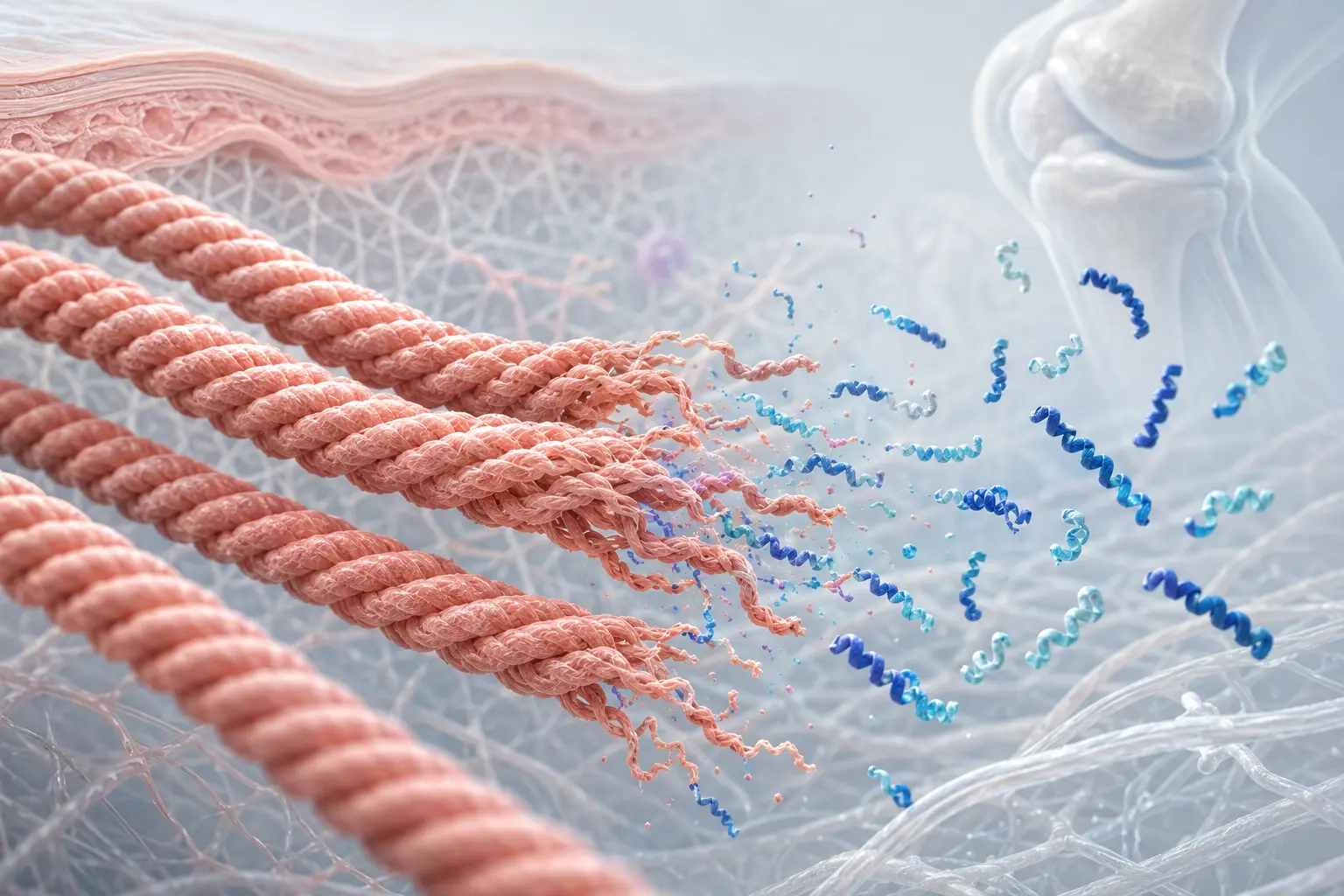
Hydrolyzed collagen peptides occupy a distinctive position in peptide research: they are orally administered, derived from a food protein, sold as dietary supplements, and have accumulated a modest but growing body of randomized controlled trial data. This makes them simultaneously more accessible to consumers and more studied by conventional clinical researchers than many synthetic peptides.
However, interpreting this literature requires understanding the unusual pharmacology of orally ingested peptides and the specific methodological issues that affect this research area.
What Collagen Peptides Are
Collagen is the most abundant structural protein in mammals, making up approximately 30% of total body protein. It consists of a triple-helix structure formed by three polypeptide chains, each containing repeating Gly-X-Y sequences (where X is frequently proline and Y is frequently hydroxyproline). This structure gives collagen its extraordinary tensile strength.
Hydrolyzed collagen (also called collagen hydrolysate or collagen peptides) is produced by enzymatic, acid, or alkaline hydrolysis of collagen from animal sources (bovine, porcine, marine, or chicken). The hydrolysis breaks the long collagen chains into shorter fragments — typically peptides of 2–12 amino acids, with an average molecular weight of approximately 2,000–5,000 Da.
The Pharmacokinetic Question
The fundamental question for oral collagen peptides is whether intact bioavailable peptides survive gastrointestinal digestion and reach target tissues. This was considered unlikely for years based on the general principle that the gut degrades proteins to individual amino acids and small dipeptides/tripeptides.
More recent research has challenged this absolute position. Several studies using tracer-labeled or mass spectrometry-based approaches have detected intact collagen dipeptides (particularly Pro-Hyp and Hyp-Gly) in human plasma after oral collagen hydrolysate ingestion. Peak plasma concentrations typically occur at 1–2 hours post-ingestion.
Whether these circulating peptide concentrations are sufficient to produce biological effects at target tissues (skin dermis, cartilage) remains a point of active research. The concentrations observed in plasma are generally in the low micromolar range.
Skin Research
The most studied indication for collagen peptides is skin aging outcomes. Randomized, placebo-controlled trials have examined:
Skin hydration: Multiple double-blind RCTs (including the Proksch et al. studies published in Skin Pharmacology and Physiology) have reported statistically significant improvements in skin hydration at 8 weeks with oral collagen peptides compared to placebo. Effect sizes are modest.
Skin elasticity: The same and similar trials have reported modest improvements in skin elasticity by tonometry. Clinical significance of these changes in otherwise healthy subjects is debated.
Wrinkle depth: Some trials using 3D skin surface analysis have reported reductions in wrinkle depth metrics. These are measured outcomes but the subjective clinical significance is variable.
The proposed mechanism is that hydroxyproline-containing collagen fragments may stimulate fibroblasts to produce new collagen and hyaluronic acid, possibly through interaction with fibroblast receptors. Some in vitro studies support this mechanism, but in vivo tissue-level confirmation (e.g., skin biopsy histology showing increased collagen density) is less consistently reported.
Joint Research
A smaller body of research has examined collagen peptides in joint-related outcomes:
Osteoarthritis: Several RCTs have examined pain and function outcomes in knee osteoarthritis. Some have reported modest reductions in pain scores and improvements in function, while others show no significant difference from placebo. A meta-analysis is difficult because of heterogeneity in patient populations, collagen preparation types, and outcome measures.
Sports-related joint pain: Studies in active individuals with activity-related joint pain have reported positive outcomes in some trials. The Clark et al. 2008 study published in Current Medical Research and Opinion is frequently cited in this context.
Limitations of the Collagen Peptide Literature
Industry funding: A significant proportion of positive RCTs in this area have been funded by collagen peptide manufacturers. Industry-funded trials are not necessarily invalid, but the association between funding source and positive outcomes is well-documented across biomedical research.
Heterogeneity of preparations: "Collagen peptides" is not a single compound — different manufacturers use different source materials, hydrolysis methods, and achieve different peptide size distributions. Results from one preparation may not generalize to others.
Placebo response in subjective outcomes: Skin and joint outcomes include significant subjective components. Adequate blinding (texture and taste matching of placebo) affects the validity of findings.
Short trial durations: Most trials run 8–12 weeks. The long-term trajectory of any effects beyond this window is not established.
Comparison with Topical Collagen
Some consumers and researchers compare oral collagen peptides to topical collagen products. Topically applied intact collagen has very poor skin penetration due to its large molecular size. Hydrolyzed fragments penetrate better but still face the inherent limitations of transdermal peptide delivery. Oral and topical represent entirely different delivery mechanisms that should be evaluated separately.
References
- 1.Proksch E, Segger D, Degwert J, Schunck M, Zague V, Oesser S. “Oral supplementation of specific collagen peptides has beneficial effects on human skin physiology: a double-blind, placebo-controlled study.” Skin Pharmacology and Physiology. 2014;27(1):47-55. doi:10.1159/000351376 [PubMed]
- 2.Clark KL, Sebastianelli W, Flechsenhar KR, Aukermann DF, Meza F, Millard RL, Deitch JR, Sherbondy PS, Albert A. “24-Week study on the use of collagen hydrolysate as a dietary supplement in athletes with activity-related joint pain.” Current Medical Research and Opinion. 2008;24(5):1485-1496. doi:10.1185/030079908x291967 [PubMed]