Peptide Bioavailability: Routes of Administration in Research
How administration route affects peptide bioavailability — why oral delivery usually fails, and what routes researchers use to study peptide activity.
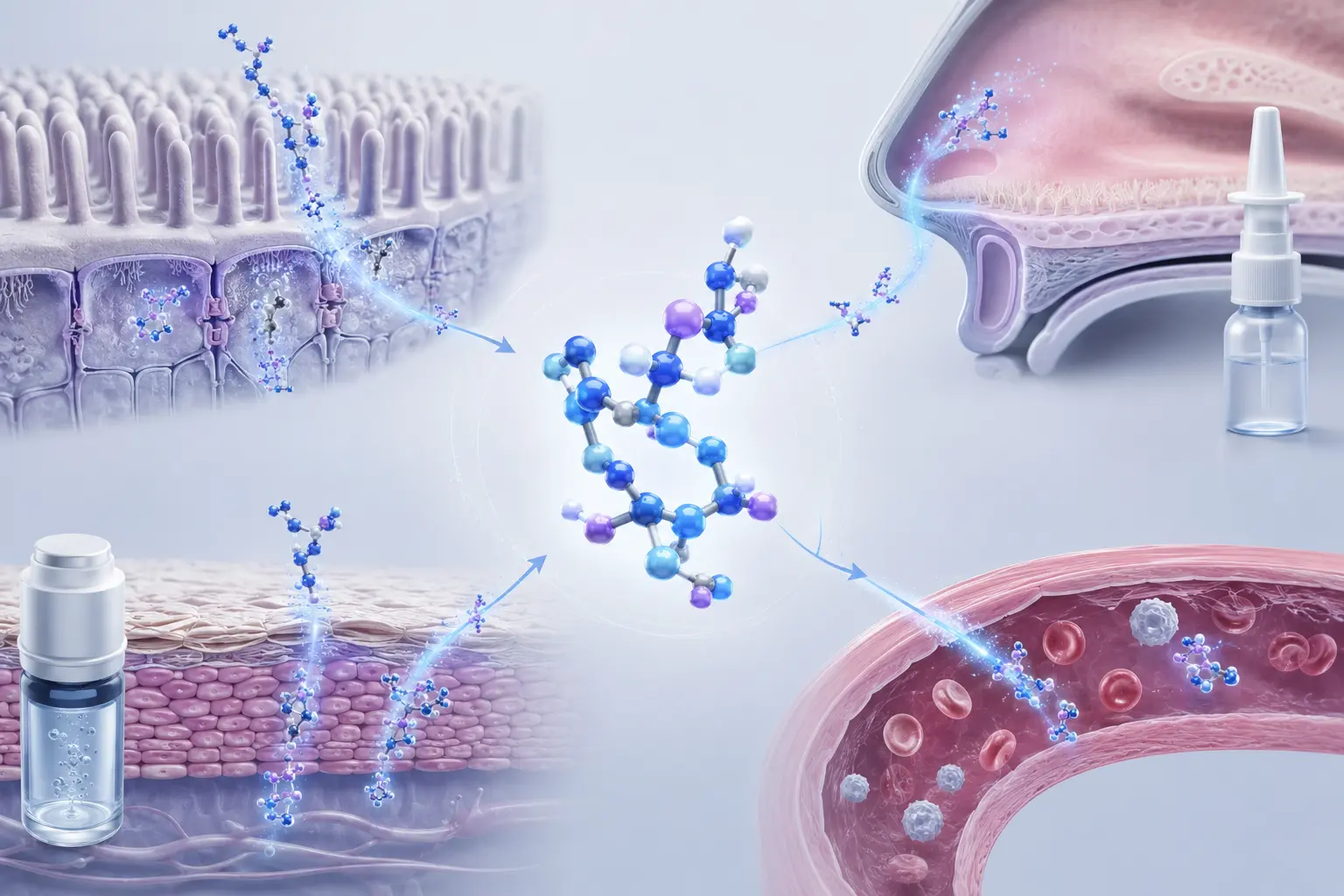
Bioavailability is the fraction of an administered dose that reaches the systemic circulation in an active form. For a complementary discussion of how quickly that active fraction disappears, see our article on peptide half-life and stability. For peptides, this is one of the most pharmacologically relevant parameters because most peptides face substantial barriers to reaching their biological targets after administration.
Understanding bioavailability is fundamental to interpreting peptide research: a compound may have robust in vitro activity but minimal in vivo effect if it cannot reach its target at an effective concentration.
Why Oral Bioavailability Is Poor for Most Peptides
The gastrointestinal tract presents multiple obstacles to intact peptide absorption:
Acid degradation: The stomach maintains a pH of approximately 1.5–3.5. Most peptides are susceptible to acid hydrolysis at this pH, particularly at the peptide bonds involving certain amino acids.
Enzymatic degradation: The small intestine contains an extensive array of peptidases — both luminal (from pancreatic secretions) and brush-border (attached to intestinal epithelium). These include endopeptidases (trypsin, chymotrypsin, elastase) that cleave internal peptide bonds and exopeptidases (carboxypeptidases, aminopeptidases) that trim termini. Most unmodified peptides longer than 2–3 amino acids are substantially degraded before they could be absorbed.
Poor epithelial transport: Even if a peptide survives GI degradation, intestinal epithelial cells present a physical barrier. Polar, hydrophilic peptides do not readily cross lipid bilayer membranes. Specialized transporters (PepT1, PepT2) handle di- and tripeptides efficiently but not larger sequences.
First-pass metabolism: Peptides absorbed via the portal system encounter hepatic peptidases before reaching systemic circulation, further reducing the effective dose.
For these reasons, the oral bioavailability of most research peptides (5+ amino acids) is typically well below 5% and often essentially zero for intact peptide.
Modifications That May Improve Oral Bioavailability
Pharmaceutical chemists have developed strategies that may improve oral peptide delivery:
- N-methylation of backbone amides: Reduces hydrogen bonding and may improve membrane permeability
- Cyclization: Cyclic peptides may have better membrane permeability than linear equivalents (cyclosporine A is a well-known example of an orally bioavailable cyclic peptide)
- Peptidomimetics: Replacing natural peptide bonds with non-hydrolyzable isosteres
- Nanoparticle or liposome encapsulation: Protective delivery systems being explored for therapeutic peptides
- D-amino acid substitution: Reduces susceptibility to L-amino acid-specific peptidases
These approaches can substantially improve oral bioavailability for specific compounds but require systematic development for each peptide.
Subcutaneous Injection
Subcutaneous (SC) injection is the most commonly reported administration route in research peptide studies. It is preferred for several reasons:
- Peptides in aqueous solution are generally stable at subcutaneous sites until absorbed
- Absorption from the subcutaneous space is primarily via lymphatic capillaries (for larger peptides) and blood capillaries (for smaller ones), bypassing first-pass hepatic metabolism
- Bioavailability via SC injection is typically high for water-soluble peptides — often 70–100%
- SC absorption creates a slower, more sustained pharmacokinetic profile compared to IV bolus
The SC route avoids the GI and hepatic obstacles entirely, which is why most in vivo research on peptides uses it as the reference route.
Intravenous (IV) Administration
IV administration is the gold standard for defining 100% bioavailability (used as the denominator when calculating other route bioavailabilities). It is used in pharmacokinetic studies requiring precise control of plasma concentration-time profiles.
In clinical practice, IV peptide administration is used for several approved peptide drugs (e.g., some forms of insulin administration historically, certain diagnostic peptides). For research peptides, IV is primarily used in animal PK studies rather than human research.
Intramuscular Injection
IM injection produces bioavailability profiles generally similar to SC for water-soluble peptides, though the absorption rate may differ based on local blood flow differences between muscle and subcutaneous tissue. Some depot formulations are designed specifically for IM use.
Intranasal Administration
The intranasal route has attracted research interest for neurological applications because of two potential advantages:
- Bypassing first-pass metabolism: Nasally absorbed compounds enter the systemic circulation through the nasal mucosa's dense vascular supply, avoiding the portal-hepatic first pass.
- Potential direct CNS delivery via the olfactory pathway: The olfactory epithelium provides anatomical continuity with the olfactory bulb. Some researchers have proposed that compounds deposited on olfactory mucosa may be transported directly to the CNS via olfactory neurons, partially bypassing the BBB. Evidence for this pathway in humans is present but quantitatively limited.
Intranasal bioavailability varies considerably by compound — nasal mucosal peptidases and the limited absorptive surface area constrain delivery. Compounds like oxytocin, desmopressin, and several research peptides (Selank, Semax) have been formulated for intranasal use.
Topical Administration
Topical application is relevant for peptides studied in dermatological contexts (e.g., collagen peptides, copper peptides, signal peptides used in cosmetics). Skin penetration of peptides depends on molecular weight, lipophilicity, and formulation. Most research peptides larger than ~500 Da have poor skin penetration without permeation enhancers.
Implications for Interpreting Research Claims
When evaluating any peptide research study or claim, the route of administration is critical context:
- An in vitro study showing activity tells you nothing about whether an orally administered version of the compound would have the same effect
- An animal study using SC injection does not establish that an oral version would be bioavailable
- Claims that a peptide is "effective" without specifying the administration route and achieved plasma concentration are incomplete
Bioavailability data should accompany any meaningful claim about a peptide's activity in a living system.