Amino Acid Chemistry: The Building Blocks of Peptides
A foundational review of the chemistry of amino acids — their structure, classification, ionization behavior, and how their properties determine the characteristics of the peptides they form.
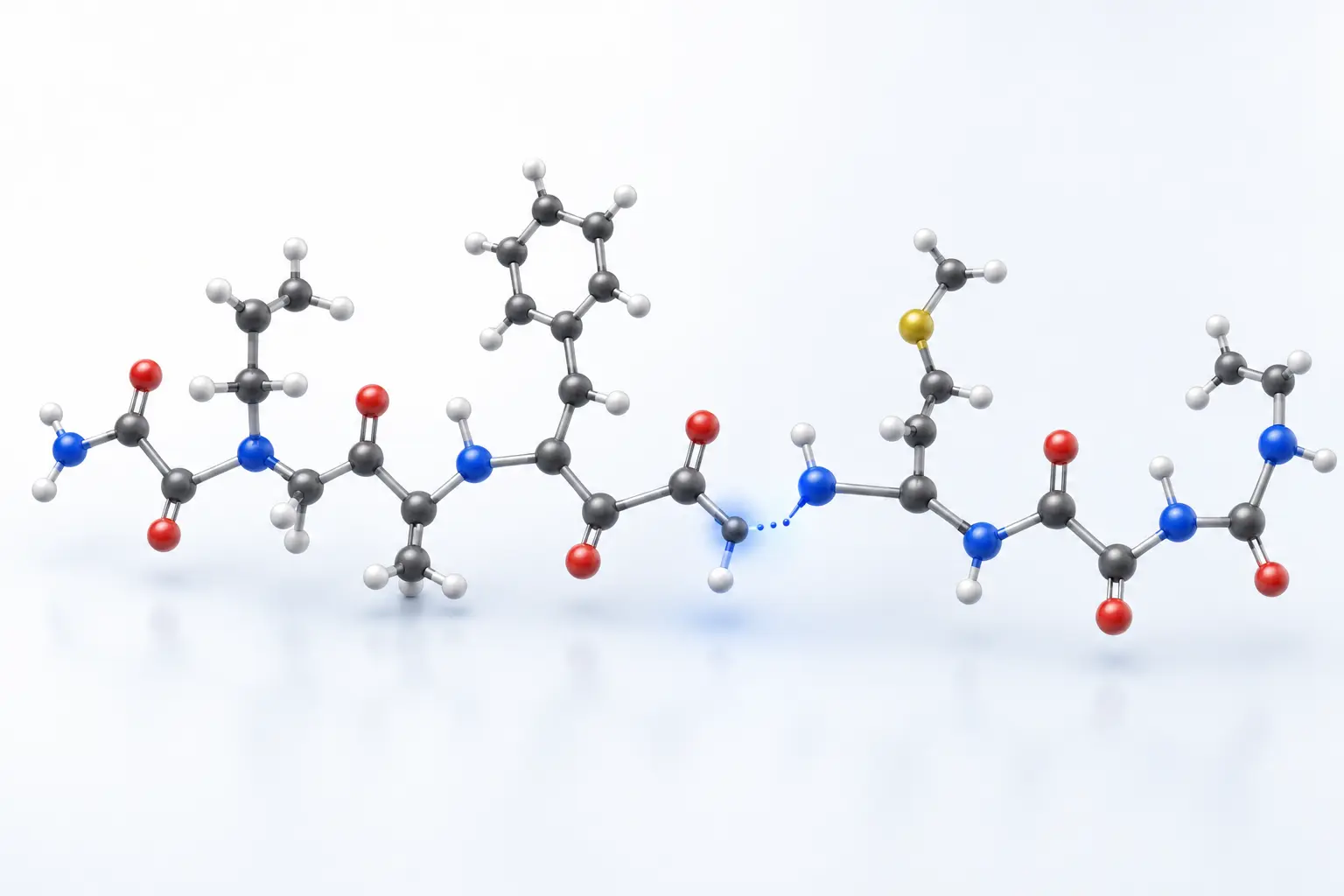
Amino acids are the monomer units from which peptides and proteins are assembled. The 20 standard amino acids specified by the genetic code share a common structural core but differ in their side chains (R groups), which determine their chemical properties and the characteristics they contribute to the peptides they form.
A thorough understanding of amino acid chemistry is foundational to interpreting peptide research, particularly when evaluating structural modifications, stability data, and receptor binding properties.
The Common Amino Acid Core
Every standard amino acid has:
- A central alpha-carbon (Cα)
- An amino group (-NH₂)
- A carboxyl group (-COOH)
- A hydrogen atom
- A side chain (R group) — the variable component
At physiological pH (~7.4), both the amino group and carboxyl group are ionized: the amino group is protonated (-NH₃⁺) and the carboxyl group is deprotonated (-COO⁻). This zwitterionic form is the predominant species for amino acids and short peptides at physiological pH.
The alpha-carbon of all standard amino acids except glycine is a chiral center — it has four different substituents. This chirality means amino acids exist as L and D enantiomers. The L-configuration is found almost exclusively in biological proteins and natural peptides. D-amino acids are rare in nature (found in some bacterial cell walls and antimicrobial peptides) but are widely used in synthetic peptide design because they resist proteolysis by most L-amino acid-specific peptidases.
Classification by Side Chain Properties
Amino acid classification by side chain chemistry predicts their contributions to peptide properties:
Nonpolar, aliphatic: Gly (G), Ala (A), Val (V), Leu (L), Ile (I), Pro (P), Met (M) These residues prefer the hydrophobic interior of proteins or membrane-embedded regions. In synthetic research peptides, clusters of nonpolar residues contribute to membrane-active properties (relevant for antimicrobial peptides) or hydrophobic receptor binding surfaces.
Aromatic: Phe (F), Tyr (Y), Trp (W) Aromatic residues can participate in pi-stacking and cation-pi interactions. Tryptophan is particularly important for GPCR binding — the DRY motif and aromatic clusters in GPCR transmembrane domains often interact with aromatic residues in peptide ligands. Many synthetic GHRPs incorporate D-Phe or D-Trp modifications specifically to interact with GHS-R1a's aromatic binding pocket.
Polar, uncharged: Ser (S), Thr (T), Cys (C), Asn (N), Gln (Q) These residues can participate in hydrogen bonding. Cysteine deserves particular attention: its thiol group (-SH) readily undergoes oxidation to form disulfide bonds (-S-S-) with other cysteines. Disulfide bonds stabilize cyclic peptide structures (defensins, oxytocin) but also represent a stability liability — cysteine-containing research peptides may dimerize or aggregate via intermolecular disulfides.
Positively charged (basic): Lys (K), Arg (R), His (H) These residues carry positive charges at physiological pH (Lys and Arg fully protonated; His partly protonated). Cationic character is critical for antimicrobial peptides (electrostatic attraction to negatively charged bacterial membranes) and for receptor binding (many peptide receptor binding pockets are negatively charged). Basic residues are also common sites for trypsin cleavage.
Negatively charged (acidic): Asp (D), Glu (E) Carry negative charges at physiological pH. Important for calcium binding, metal coordination, and receptor interactions. Glutamic acid appears in many naturally occurring peptides and GHRH analogs.
Proline: The Conformational Constrainer
Proline deserves special discussion because its structure is uniquely different from other amino acids. In proline, the side chain forms a ring that includes the backbone nitrogen, creating a secondary amine rather than a primary amine. This has profound conformational consequences:
- Proline cannot participate in regular alpha-helix hydrogen bonding as a donor
- It introduces a rigid kink into peptide chains
- Proline-containing peptide bonds have a much higher proportion of the cis isomer than other peptide bonds
- Proline is a preferred substrate of DPP-4 (the enzyme that rapidly degrades GLP-1, GHRH, and other peptides)
The appearance of Pro-Gly-Pro extensions in synthetic peptides like Semax and Selank, and proline substitutions in various research peptides, reflects deliberate use of proline's conformational and stability properties.
Non-Standard Amino Acids in Research Peptides
Many synthetic research peptides incorporate non-standard amino acids — building blocks not found in natural proteins:
D-amino acids: Mirror images of standard L-amino acids. Confer protease resistance. D-Trp, D-Phe, D-Ala, D-Lys are commonly used. Identified in peptide sequences by lowercase or "D-" prefix: D-Trp or d-Trp.
Aib (α-aminoisobutyric acid): Alpha-methyl amino acid. Induces helix formation and confers protease resistance. Found in ipamorelin and other synthetic GHSs.
Nle (norleucine): A methionine analog without the sulfur atom, used where Met might be undesirable due to oxidation susceptibility.
2-Nal (2-naphthylalanine): A large aromatic non-natural amino acid. Appears in ipamorelin (D-2Nal) and several other research peptides, selected for specific receptor binding interactions.
From Amino Acids to Peptide Properties
The amino acid composition of a peptide predicts several properties relevant to research:
| Property | Key Amino Acid Determinants |
|---|---|
| Net charge at pH 7.4 | Count of basic residues (Lys, Arg, His) minus acidic (Asp, Glu) |
| Hydrophobicity | Proportion of nonpolar and aromatic residues |
| Protease susceptibility | Presence of cleavage sequences (e.g., -X-Pro- for DPP-4) |
| Oxidation risk | Methionine, cysteine, tryptophan content |
| Aggregation tendency | Hydrophobic patches, beta-sheet propensity |
| Membrane interaction | Amphipathic character when helical |
These relationships are why synthetic peptide design requires careful consideration of amino acid substitutions: changing even a single residue can alter charge, stability, receptor binding, and pharmacokinetic behavior simultaneously.