Understanding Antimicrobial Peptides: Nature's Defense Molecules
Antimicrobial peptides (AMPs) overview: naturally occurring peptides in innate immunity, covering mechanism of action, classification, and research potential.
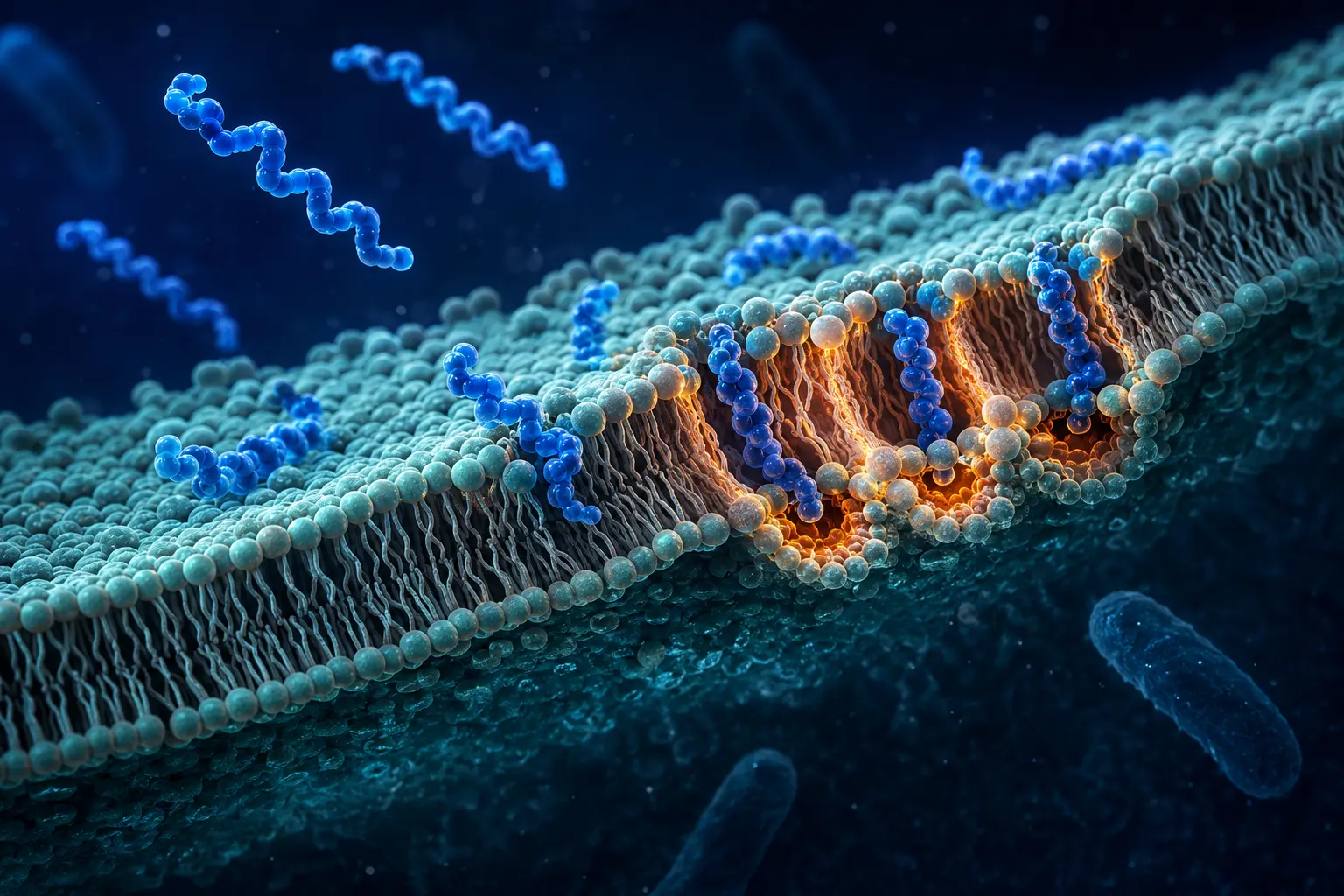
Antimicrobial peptides (AMPs) are a structurally diverse class of short peptides found across virtually all forms of life — from bacteria (which use bacteriocins to compete with other bacteria) to plants, insects, amphibians, and mammals. In animals, AMPs form an essential component of innate immunity, providing rapid defense against pathogens before the slower adaptive immune response mobilizes.
Research interest in AMPs has intensified significantly in recent decades in the context of the antibiotic resistance crisis. AMPs may offer potential scaffolds for new antimicrobial strategies, though significant challenges remain before most AMPs can be considered viable drug candidates.
Structural Diversity and Classification
Unlike many peptide classes defined by a receptor target or biosynthetic precursor, AMPs are unified primarily by their function. They exhibit enormous structural diversity:
Alpha-helical AMPs: Upon contact with bacterial membranes, these peptides adopt an amphipathic helix (with hydrophilic residues on one face, hydrophobic on the other). Examples include magainins (from African clawed frog skin) and LL-37 (human cathelicidin).
Beta-sheet AMPs: Stabilized by disulfide bonds that constrain the structure. Human defensins are the primary example — alpha-defensins (found in neutrophils and small intestinal Paneth cells) and beta-defensins (expressed on epithelial surfaces throughout the body).
Loop or lasso structures: Some AMPs adopt constrained loop structures maintained by disulfide or isopeptide bonds.
Non-ribosomal peptides: Bacterial AMPs like polymyxins are synthesized by multi-enzyme complexes rather than ribosomes and contain non-standard amino acids.
Mechanisms of Action
AMPs may work through several distinct mechanisms, which differ from conventional antibiotics in important ways:
Membrane disruption: The most studied mechanism. Cationic AMPs (positively charged) are attracted to bacterial membranes (which have a net negative charge from phosphatidylglycerol and cardiolipin) rather than mammalian membranes (which present primarily neutral phosphatidylcholine). Several models have been proposed for how AMPs disrupt bacterial membranes:
- Barrel-stave model: AMPs insert perpendicular to the membrane and aggregate to form pores, like staves in a barrel
- Toroidal pore model: AMPs insert at an angle, causing membrane bending and forming transient toroidal pores
- Carpet model: AMPs cover the membrane surface at high density and disrupt it by detergent-like solubilization
Intracellular targets: Some AMPs cross intact bacterial membranes without permanent disruption and target intracellular functions — DNA binding, ribosome inhibition, or interference with cell wall synthesis.
Human AMPs
Humans produce numerous AMPs with roles in host defense:
Cathelicidin (LL-37): The only human cathelicidin. Expressed in neutrophils, macrophages, and epithelial cells. May have direct antimicrobial activity and immunomodulatory functions. Research has examined LL-37's potential roles in inflammatory skin conditions and its regulation by vitamin D.
Defensins: Humans express alpha-defensins (HNP 1–4 in neutrophils; HD5, HD6 in intestinal Paneth cells) and beta-defensins (HBD 1–4 on epithelial surfaces). Beta-defensin-2 expression is inducible by bacterial products and inflammatory cytokines, making it part of the regulated innate immune response.
Histatins: Proline- and histidine-rich peptides in saliva with antifungal activity, particularly against Candida species.
Why AMPs Resist Resistance
A compelling theoretical feature of membrane-disrupting AMPs is that bacterial resistance is more difficult to develop compared to conventional antibiotics. Resistance to a membrane-disrupting mechanism requires fundamentally altering the lipid composition of the bacterial membrane — a change that would impair membrane function itself. In practice, some resistance mechanisms exist but are less common than resistance to targeted antibiotics.
This theoretical advantage has motivated substantial pharmaceutical interest in AMP-derived drug development.
Challenges in AMP Drug Development
Despite decades of research, only a small number of AMP-derived drugs have reached clinical use (polymyxins, gramicidin in topical preparations). The challenges are significant:
Toxicity to mammalian cells: At concentrations required for antimicrobial effect, many AMPs also disrupt mammalian cell membranes. The selectivity ratio (bacterial MIC vs. mammalian cytotoxicity) must be sufficient for therapeutic use.
Proteolytic instability: Most natural AMPs have short half-lives in vivo due to protease activity. Achieving sufficient concentrations at infection sites requires either local application or structural modifications that improve stability.
Cost of synthesis: Producing AMPs at pharmaceutical scale is significantly more expensive than synthesizing conventional small-molecule antibiotics.
Formulation challenges: AMPs often require special formulation approaches to maintain activity and prevent degradation.
Research Directions
Current AMP research directions include:
- Synthetic peptidomimetics: Designing molecules that mimic AMP structure and function but are not natural peptides, potentially improving stability and reducing manufacturing cost
- Topical applications: Wound care, skin infections, and catheter coatings — areas where systemic stability is less critical
- Phage display and combinatorial approaches: Screening large libraries for AMPs with improved selectivity
- Understanding the microbiome interaction: How endogenous AMPs shape the composition of the gut and skin microbiome
AMPs remain an active and promising research area, but the path from laboratory discovery to approved drug has proven longer and more difficult than early optimism suggested.