Peptide Half-Life and Stability: What Researchers Measure
An explanation of plasma half-life, metabolic stability, and the chemical strategies researchers use to extend the active duration of synthetic peptides in biological systems.
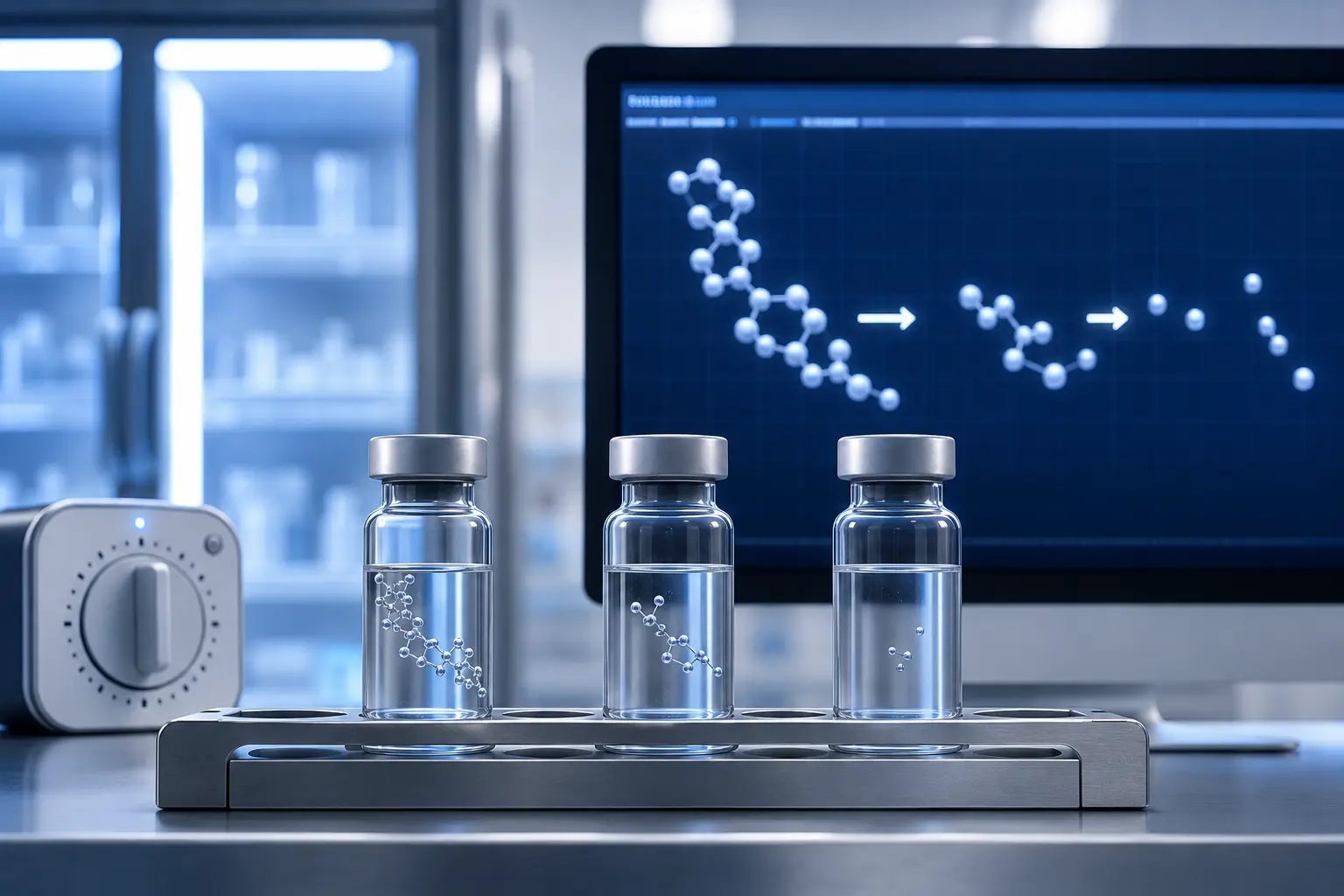
Plasma half-life (t½) is the time required for the plasma concentration of a compound to fall by 50% after administration. For peptides, this is typically determined by the rate of enzymatic degradation rather than renal or biliary excretion (though both can contribute for larger peptides or peptide metabolites).
Understanding half-life is essential for designing research protocols — it determines dosing frequency, the duration of measurable effects, and the window during which plasma concentration is above any proposed effective threshold.
Why Natural Peptides Have Short Half-Lives
Endogenous peptides — the body's own signaling molecules — are often designed by evolution to have short half-lives. A hormone that circulates for hours when the physiological need lasted minutes would create persistent, unregulated signaling. The body's peptidase systems have co-evolved to degrade signaling peptides promptly.
For research applications, this presents a practical challenge: the peptides most interesting to study are often those that mimic natural signals, but their short natural half-lives may limit achievable plasma concentrations and duration.
Major Peptidase Classes That Degrade Research Peptides
Dipeptidyl peptidase-4 (DPP-4): A ubiquitous serine protease present in plasma and on many cell surfaces. It cleaves dipeptides from the N-terminus when the second amino acid is proline or alanine. This enzyme is responsible for rapid degradation of GLP-1, GHRH, and many other N-terminally exposed peptides. DPP-4 inhibitors (gliptins) are approved drugs that work precisely by blocking this degradation.
Neprilysin (neutral endopeptidase 24.11): Cleaves peptides at the N-terminal side of hydrophobic residues. Involved in degradation of atrial natriuretic peptide, bradykinin, and various neuropeptides.
Angiotensin-converting enzyme (ACE): A dipeptidyl carboxypeptidase that removes two amino acids from the C-terminus. Beyond its role in the renin-angiotensin system, ACE can degrade a variety of bioactive peptides.
Aminopeptidases: Remove amino acids from the N-terminus. Plasma contains multiple aminopeptidases with different substrate specificities.
Endopeptidases (trypsin-like, chymotrypsin-like): Cleave at internal peptide bonds at positions determined by the flanking amino acid identity.
Half-Life Values: Context for Common Research Peptides
Half-life values from published pharmacokinetic studies provide useful reference points:
| Peptide | Reported t½ | Route Studied | Notes |
|---|---|---|---|
| Native GHRH | ~6–8 min | IV | DPP-4 substrate at Ala2 |
| GHRP-6 | ~15–20 min | SC | Animal PK data |
| Ipamorelin | ~2 h | SC | D-amino acids improve stability |
| CJC-1295 (DAC) | ~6–8 days | SC | Albumin binding extends t½ |
| Native GLP-1 | ~2 min | IV | Rapidly cleaved by DPP-4 |
| Semaglutide | ~7 days | SC | Albumin binding + modifications |
These values illustrate the enormous range achievable through structural modification.
Strategies for Extending Peptide Half-Life
D-amino acid substitution: The most common strategy for research peptides. Substituting L-amino acids at peptidase cleavage sites with their D-enantiomers typically confers resistance to that enzyme without necessarily affecting receptor binding (if the receptor accommodates the D configuration).
N-terminal modification: Acetylation of the alpha-amine, addition of PEG groups, or cyclization can block aminopeptidase access. The Pro-Gly-Pro additions seen in Semax and Selank serve partially this function.
C-terminal amidation: Converting the C-terminal carboxyl group (-COOH) to an amide (-CONH₂) blocks carboxypeptidase activity. Very common in synthetic research peptides — a terminal "-NH₂" in a peptide's name indicates C-terminal amidation.
Albumin binding (DAC technology): Creating a reactive group that forms a covalent or high-affinity reversible bond with serum albumin dramatically extends circulation time. CJC-1295 uses this approach; pharmaceutical semaglutide uses a reversible albumin-binding fatty acid chain.
PEGylation: Attaching polyethylene glycol (PEG) chains increases molecular size (reducing renal filtration), shields from proteases, and reduces immunogenicity. Used in approved pharmaceutical peptides.
Cyclization: Forming a cyclic structure via head-to-tail or side-chain bonds creates a more rigid conformation that may resist enzymatic attack and improve receptor binding geometry.
Measurement Methods
Researchers measure peptide half-life using mass spectrometry (LC-MS/MS) or radioimmunoassay (RIA) of time-serial plasma samples following controlled administration. For very short half-life compounds, frequent sampling (every 1–2 minutes early post-injection) is required to capture the initial concentration curve.
In vitro stability assays — incubating peptides in plasma and measuring intact peptide over time — are used as a preliminary screen before animal PK studies.
Why Half-Life Matters When Evaluating Claims
When reviewing claims about a research peptide, the half-life is essential context. A compound with a 10-minute half-life will reach less than 1% of its peak plasma concentration within an hour of a single injection. Claims about "sustained effects" from such a compound require either:
- Very frequent re-dosing
- Downstream effects that persist after the compound has cleared
- Evidence for mechanism of action that explains sustained effects despite rapid clearance
All three are possible in principle, but they require specific evidence, not assumption.