Peptide Purity Testing: HPLC and Mass Spectrometry Explained
How HPLC and mass spectrometry verify research peptide purity and identity — and what researchers should look for in a certificate of analysis.
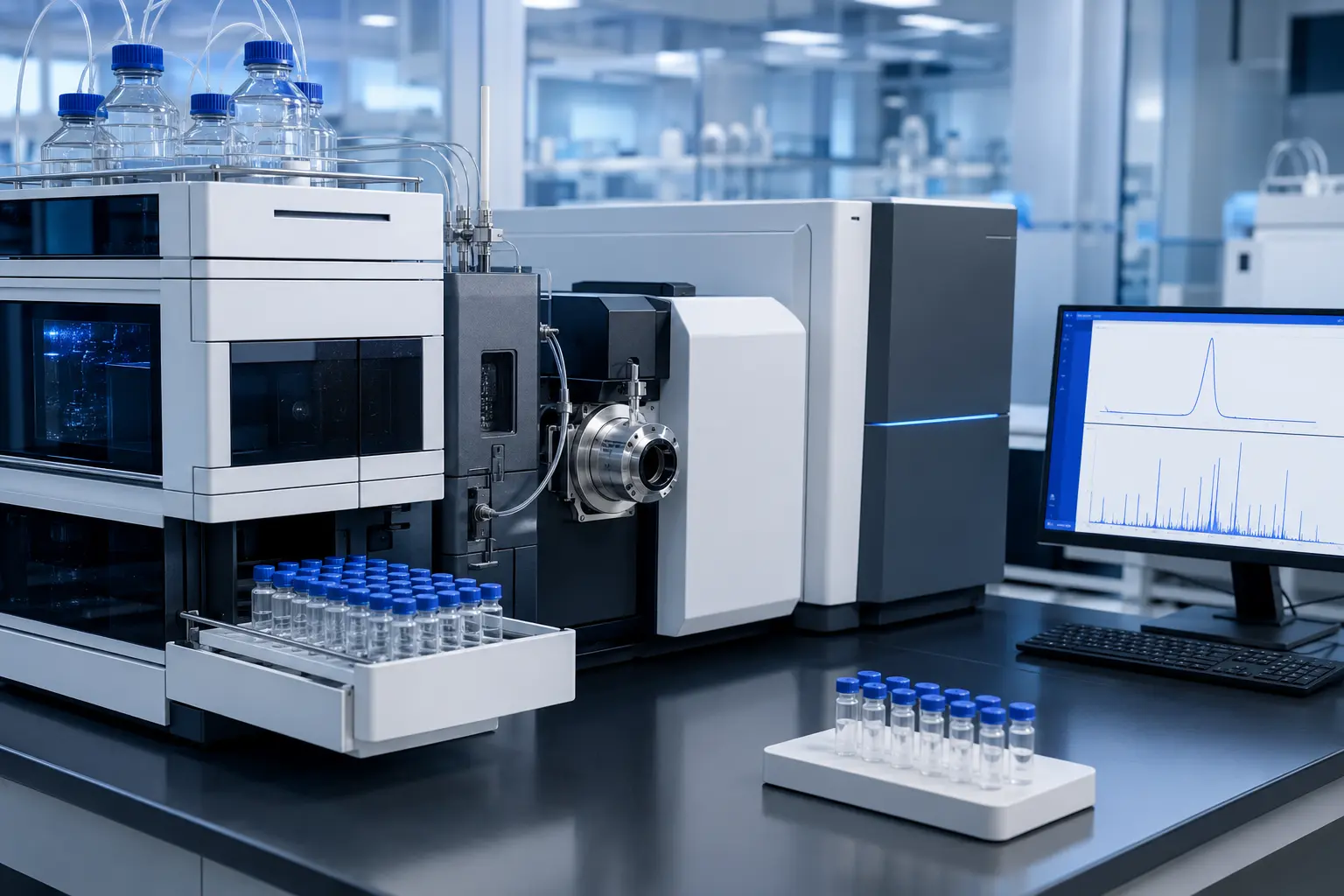
When working with research peptides, purity and identity verification are not procedural formalities — they are prerequisites for meaningful experimental interpretation. Using a peptide of unknown purity or unverified identity introduces confounding variables that can invalidate conclusions.
This article explains the two primary analytical methods used to characterize research peptides: reversed-phase HPLC for purity assessment and mass spectrometry for identity confirmation.
Reversed-Phase High-Performance Liquid Chromatography (RP-HPLC)
HPLC separates compounds based on their differential interaction with a stationary phase (the column packing) and a mobile phase (the solvent flowing through the column). Reversed-phase HPLC uses a hydrophobic stationary phase (typically C18 or C8 alkyl chains bonded to silica particles) and a polar aqueous mobile phase.
How the separation works: In the initial mobile phase (mostly water/buffer), hydrophilic compounds pass through the column quickly (low retention). As the concentration of organic solvent (usually acetonitrile or methanol) is increased in a gradient, compounds begin to elute in order of increasing hydrophobicity. A peptide with more hydrophobic residues will elute later in the gradient than a more hydrophilic variant.
Detection: Most peptide HPLC uses UV detection at 214 nm. This wavelength detects the peptide bond absorbance (n→π* transition), making it useful for detecting all peptides regardless of the specific amino acids present. Some aromatic residues (Phe, Trp, Tyr) also absorb at 280 nm, which is sometimes used as a supplementary detector.
Purity calculation: The chromatogram (absorbance vs. time) shows peaks for each compound in the mixture. Purity is typically reported as:
% Purity = (Peak area of target compound / Total peak area) × 100
A purity of ≥98% by HPLC means that 98% or more of the detectable material corresponds to the target peptide peak.
What HPLC does not tell you: HPLC purity measures relative peak areas, not absolute mass. A sample that is "98% pure" by HPLC could still contain significant non-UV-absorbing impurities (water, counterions, solvent residues) that affect the actual peptide content by mass. Purity and potency are related but not identical concepts.
Mass Spectrometry (MS)
Mass spectrometry measures the mass-to-charge ratio (m/z) of ionized compounds. For peptides, two soft ionization techniques are used:
Electrospray ionization (ESI): The peptide solution is sprayed through a charged needle, producing multiply-charged ions. A 2000 Da peptide might appear as (M+2H)²⁺ at m/z = 1001, (M+3H)³⁺ at m/z = 668, etc. ESI is the most common technique for peptide identity confirmation.
MALDI (Matrix-Assisted Laser Desorption Ionization): The peptide is co-crystallized with an energy-absorbing matrix compound and ionized by a laser pulse. MALDI typically produces singly-charged ions and is commonly used for molecular weight confirmation.
Identity confirmation: By measuring the m/z of peptide ions and calculating the molecular mass from the charge state, researchers can confirm the molecular weight matches the expected value for the target sequence. A tolerance of ±1 Da is typical for well-calibrated instruments.
What MS confirms and what it doesn't: Mass spectrometry confirms molecular weight. It does not distinguish between stereoisomers (L vs. D amino acid at the same position) or sequence isomers (peptides with the same amino acids in different order). These limitations mean MS identity confirmation is necessary but not sufficient for complete characterization.
What a Complete Certificate of Analysis Should Include
A reputable research peptide supplier should provide documentation including:
| Parameter | Method | Acceptance Criteria |
|---|---|---|
| Chemical name / sequence | Text | Full amino acid sequence specified |
| Molecular formula and weight | Calculated from sequence | Provided for reference |
| HPLC purity | RP-HPLC with UV detection | ≥95%, ≥98% for research grade |
| Identity | ESI-MS or MALDI-MS | Observed mass within tolerance |
| Appearance | Visual | White to off-white lyophilized powder |
| Residual solvents | GC or Karl Fischer | Per ICH Q3C guidelines |
| TFA content | NMR or ion chromatography | Optional but informative |
TFA Content: An Underappreciated Variable
Most research peptides are synthesized using Fmoc SPPS and cleaved with trifluoroacetic acid (TFA). Residual TFA in the final product can be substantial — sometimes representing 10–20% of the measured "peptide" mass, with the TFA counterion tightly associated with basic residue amines.
This matters for dosing calculations: a vial labeled "10 mg peptide" that contains 15% TFA actually contains approximately 8.5 mg of peptide by molecular weight. Some researchers dose by mass without accounting for TFA content.
High-quality peptide preparations undergo acetate exchange or gel filtration to reduce TFA content, and this should be specified in the CoA.
Applying This Knowledge
This topic pairs naturally with How to Read a Peptide Research Study: A Practical Guide, because analytical quality control is one of the first things to check when evaluating whether a study's conclusions are trustworthy.
When evaluating a research peptide supplier or reviewing a published study:
- Ask for or review the HPLC chromatogram, not just the purity number
- Verify that MS identity is provided, not assumed
- Check whether TFA content is noted
- Note the lot number — purity can vary between synthesis batches
These are minimum standards for responsible research practice with synthetic peptides.