Reconstituting and Storing Research Peptides: A Practical Guide
How to reconstitute and store lyophilized research peptides: solvent choice, storage temperatures, and how to minimize degradation and preserve integrity.
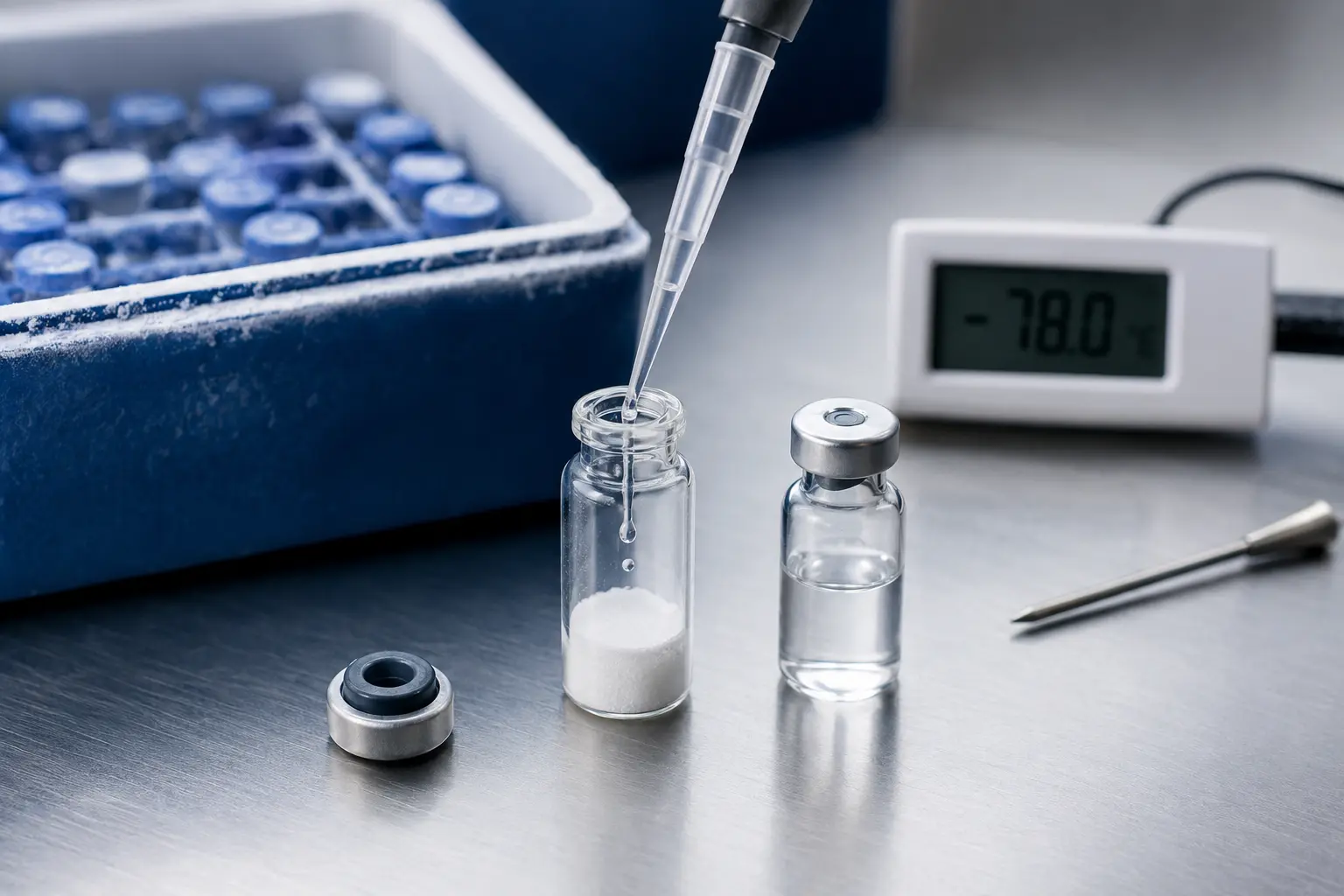
Research peptides are typically supplied as lyophilized (freeze-dried) powders, a form that maximizes shelf stability during shipping and storage. Before use in biological research, they must be reconstituted into an appropriate solution. The choices made during reconstitution and subsequent storage may significantly affect peptide stability, concentration accuracy, and the validity of experimental results.
Why Lyophilization?
Lyophilization removes water from a frozen peptide solution by sublimation under vacuum. The resulting dry powder is more stable than a solution because:
- Hydrolysis reactions (water-mediated peptide bond cleavage) cannot occur in the absence of water
- Oxidation reactions are slowed
- Microbial growth is impossible in dry, sterile conditions
- The product can be stored at higher temperatures than a solution
A properly lyophilized peptide in a sealed vial under inert gas can retain stability for 1–3+ years at -20°C.
Choosing a Reconstitution Solvent
The appropriate solvent depends on the peptide's physicochemical properties, particularly its charge and hydrophobicity.
Sterile water: Suitable for highly water-soluble peptides with good aqueous solubility. Many basic peptides (positively charged at physiological pH) and hydrophilic sequences dissolve readily in water.
Acetic acid (0.1–1%): Dilute acetic acid is commonly used for basic peptides that are insoluble in pure water. The acid protonates basic residues (Lys, Arg, His), increasing positive charge and improving aqueous solubility. This is not suitable for acid-sensitive sequences.
Phosphate-buffered saline (PBS): Appropriate for many peptides that will be used in cell culture or animal studies where osmolarity and pH matter.
DMSO (dimethyl sulfoxide): Used for highly hydrophobic peptides that cannot be dissolved in aqueous solvents. DMSO solutions should typically be diluted to ≤0.1% v/v in aqueous media for biological use to avoid cytotoxicity.
Ethanol or acetonitrile: Sometimes used at low concentrations for initial dissolution of difficult peptides before dilution into aqueous buffer.
What to avoid: Do not use solvents not compatible with the study system. Never use DMSO at >1% in cell culture without controls for solvent effects. Avoid organic acids like TFA-containing solvents in biological applications.
Reconstitution Protocol
A general approach for research use:
- Allow the sealed vial to equilibrate to room temperature before opening (prevents condensation contaminating the lyophilized cake)
- Add solvent slowly, directing it against the vial wall rather than directly onto the cake
- Gently rotate or rock — do not vortex vigorously (peptide aggregation and degradation can result from excessive mechanical stress, particularly for cysteine-containing sequences prone to disulfide formation)
- If incomplete dissolution occurs after gentle mixing, brief sonication in a low-power ultrasonic bath may help for some sequences
- Allow to sit undisturbed for 5–10 minutes if needed — some peptides require time to fully hydrate
Calculating Concentration
Most researchers prepare a known volume from a known starting mass to achieve a target concentration (mg/mL or molar). For example, to prepare 1 mg/mL stock:
Add 1 mL solvent to 1 mg peptide → 1 mg/mL stock solution
For molar concentration:
Concentration (mM) = (Mass in mg / Molecular weight in g/mol) × (1000 / Volume in mL)
Account for TFA content: If the CoA reports significant TFA, the actual peptide content is lower than the labeled mass. For precise work, calculate using the net peptide content.
Storage of Reconstituted Solutions
Once reconstituted, peptide stability decreases significantly compared to the lyophilized form:
Short-term (days): Refrigerated at 2–8°C, protected from light. Oxidation-sensitive peptides (those containing Met, Cys, Trp) are particularly vulnerable.
Medium-term (weeks to months): Aliquot into single-use volumes and freeze at -20°C or -80°C. Repeated freeze-thaw cycles accelerate degradation — each cycle subjects the peptide to mechanical stress and potential oxidation exposure.
Long-term: -80°C is preferred for most research peptides for storage beyond 3 months in solution. Lyophilized storage at -20°C is generally preferable to long-term solution storage.
Stability Threats to Watch For
Oxidation: Methionine and cysteine residues are most susceptible. Working under low-oxygen conditions (argon or nitrogen blanketing of the vial) and adding trace antioxidants (ascorbic acid at low concentrations) can reduce oxidative degradation.
Aggregation: Many peptides form aggregates in solution over time, particularly at higher concentrations. Aggregation reduces effective monomer concentration and can produce particles that cause problems in in vivo studies. Monitor for cloudiness and discard solutions that become turbid.
Disulfide crosslinking: Cysteine-containing peptides readily form inter-molecular disulfide bonds. Work at reducing conditions or use low pH (disulfide formation is favored at neutral to alkaline pH) to minimize this.
Adsorption: Peptides can adsorb to glass or plastic surfaces, particularly at low concentrations. Low-binding polypropylene tubes are preferred. Adding carrier protein (BSA at 0.1%) can block adsorption sites but introduces a variable that may affect cell-based assays.
Documentation Practices
Researchers should record the reconstitution date, solvent used, concentration achieved, and storage conditions for every peptide preparation. This documentation supports reproducibility and helps identify whether observed changes in experimental results over time may relate to peptide degradation rather than biological variation.