How Peptides Are Synthesized: Solid-Phase Peptide Synthesis
An overview of solid-phase peptide synthesis (SPPS), the standard method for manufacturing research peptides, covering the chemistry and purity considerations.
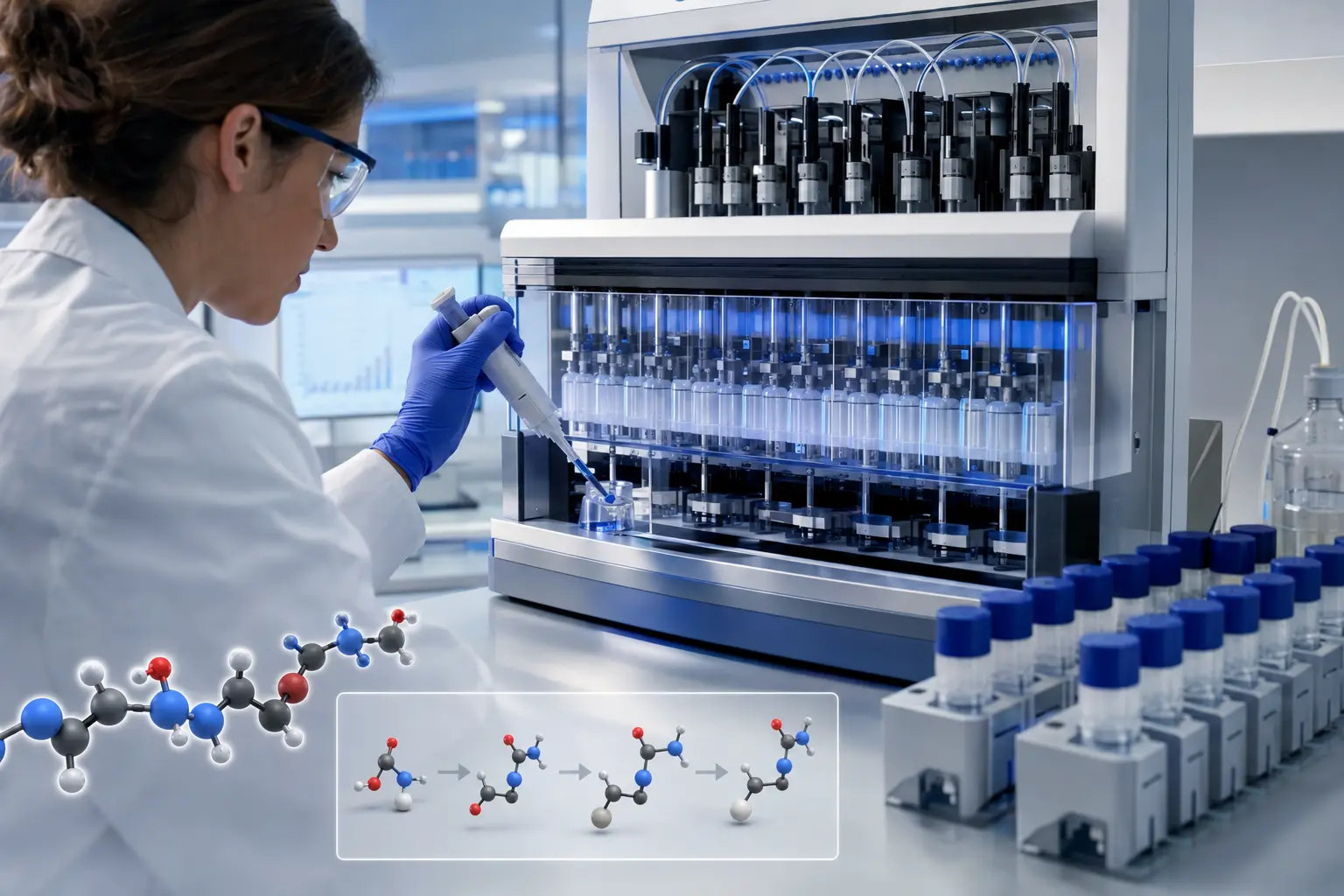
Most research peptides used today are manufactured using solid-phase peptide synthesis (SPPS), a technique developed by Robert Bruce Merrifield in the 1960s — work for which he received the Nobel Prize in Chemistry in 1984. Understanding the basics of SPPS helps researchers interpret purity certificates, understand impurity sources, and evaluate the quality of peptide preparations.
The Principle of Solid-Phase Synthesis
In SPPS, peptides are assembled on an insoluble solid support (a polymer resin) by sequentially adding protected amino acids from the C-terminus to the N-terminus. The key insight of the solid-phase approach is that the growing peptide chain is anchored to the resin, making it easy to remove soluble reagents and byproducts by filtration after each coupling step — without needing to isolate the intermediate peptide at each stage.
The process can be summarized as a cycle:
- Deprotection: Remove the temporary protecting group from the N-terminus of the most recently added amino acid
- Coupling: React the deprotected N-terminus with the next protected amino acid (activated as a reactive ester or similar)
- Capping: React any unreacted free amines with a capping agent to prevent them from producing truncated sequences
- Wash: Remove excess reagents
- Repeat for each amino acid in the sequence
When the full sequence is assembled, the peptide is cleaved from the resin and permanent side-chain protecting groups are removed simultaneously.
Protecting Group Strategies
Two main SPPS strategies are in widespread use, differing in their protecting group chemistries:
Boc (tert-butyloxycarbonyl) strategy: Uses acid-labile Boc groups for temporary N-terminal protection, with acid-stable groups protecting side chains. Cleavage from resin requires strong acid (HF or TFMSA). Historically important and still used for some applications.
Fmoc (9-fluorenylmethoxycarbonyl) strategy: Uses base-labile Fmoc groups for N-terminal protection and acid-labile groups for side-chain protection and cleavage. Milder conditions overall; now the dominant strategy for most research peptide synthesis.
Sources of Impurities in Synthetic Peptides
Every step in SPPS is less than 100% efficient, which means impurities accumulate. For a 15-amino-acid peptide assembled over 15 coupling cycles, even 99% coupling efficiency per step would result in a theoretical yield of approximately 86% of fully-correct sequence — with 14% consisting of truncated, deleted, or otherwise incorrect sequences.
Common impurity types in synthetic peptides include:
| Impurity Type | Origin | Significance |
|---|---|---|
| Deletion sequences | Missed coupling at one position | Can have different biological activity |
| Truncated sequences | Incomplete deprotection or cleavage | Typically less active |
| Oxidized residues | Methionine/cysteine oxidation during synthesis | May alter binding characteristics |
| Racemization products | Amino acid stereochemistry scrambled during coupling | D-amino acid contamination |
| Protecting group remnants | Incomplete removal during cleavage | Potential toxicity |
| Dimer/oligomers | Disulfide formation or aggregation | Activity varies |
This is why purity testing is not optional — it is essential context for interpreting any peptide research result.
Purification Methods
After initial synthesis and cleavage, crude peptides are purified using reversed-phase high-performance liquid chromatography (RP-HPLC). The peptide is dissolved in an aqueous mobile phase and separated based on hydrophobicity as organic solvent (typically acetonitrile) concentration is increased.
Multiple HPLC fractions are collected, and fractions containing the target peptide (confirmed by mass spectrometry) are pooled. This purification step can achieve peptide purities of >95% or >99% depending on requirements.
Understanding a Certificate of Analysis (CoA)
Research peptides should be accompanied by a certificate of analysis (CoA) reporting:
Purity by HPLC: The percentage of the total peak area that corresponds to the target peptide peak. A ≥98% HPLC purity is generally considered appropriate for biological research. Lower purity preparations introduce uncertainty about which compound is producing observed effects.
Identity by mass spectrometry: Typically reported as observed m/z (mass-to-charge ratio), confirmed against the calculated molecular weight. This establishes that the correct peptide was synthesized.
Appearance: Physical description — most peptides are white to off-white powders.
Moisture and counterion content: Relevant for calculating actual peptide content vs. total weight (lyophilized peptides retain water and often contain counterions like TFA or acetate that contribute to mass without contributing to peptide content).
Implications for Research Interpretation
When reviewing claims about peptide effects — especially in cell culture or animal studies — the purity and characterization of the compound used are critical variables. A study using a 70% pure peptide preparation may be observing effects from one or more of the 30% impurities rather than the target compound. High-quality research should specify peptide source, lot number, purity, and the analytical methods used to confirm it.