Neuropeptides: An Introduction to Peptides in the Nervous System
An overview of neuropeptides — peptides that act as signaling molecules in the central and peripheral nervous systems — covering their classification, release mechanisms, and research significance.
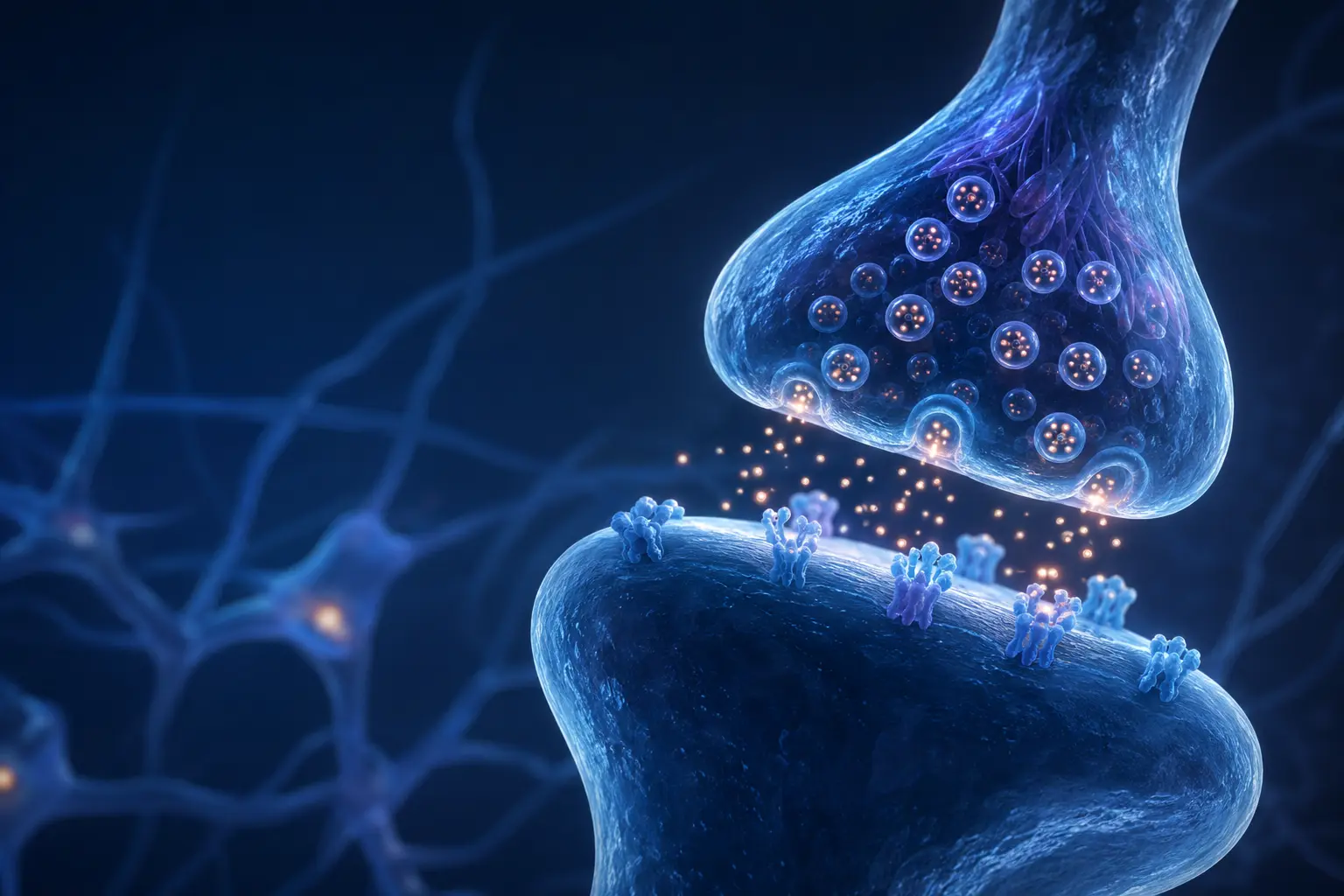
Neuropeptides are a broad class of peptides that function as signaling molecules in the nervous system. They are produced and released by neurons and, in some cases, by glial cells, and they interact with specific receptors to modulate neuronal activity, synaptic transmission, and behavior.
Unlike classical neurotransmitters (such as glutamate or GABA), neuropeptides are typically larger molecules synthesized in the neuron's cell body, packaged into dense-core vesicles, and released in a calcium-dependent manner. Their signaling characteristics differ from small-molecule neurotransmitters in several important ways that researchers must account for when designing studies.
How Neuropeptide Signaling Differs from Classical Neurotransmission
Understanding the differences between neuropeptide signaling and classical neurotransmission is fundamental to interpreting neuropeptide research correctly.
Synthesis location: Classical neurotransmitters can often be synthesized locally at the synapse. Neuropeptides are synthesized in the cell body and transported to terminals, creating a supply that cannot be rapidly replenished after release.
Release threshold: Neuropeptides are typically released under conditions of high-frequency or burst neuronal firing, not at the low frequencies sufficient to release classical neurotransmitters. This means neuropeptides are more likely to be released during intense or sustained neuronal activity.
Volume transmission: Unlike classical neurotransmitters that act primarily at the synapse, neuropeptides may diffuse over longer distances and act on receptors distant from their release site — a process called volume transmission or paracrine signaling.
Receptor kinetics: Neuropeptide receptors are almost exclusively G protein-coupled receptors (GPCRs). Their signaling cascades produce slower, more prolonged effects compared to ionotropic receptors used by classical neurotransmitters.
Major Neuropeptide Families
Researchers have catalogued hundreds of neuropeptides. They are typically classified by their biosynthetic precursors and structural features:
| Family | Examples | Primary Research Interest |
|---|---|---|
| Opioid peptides | Endorphins, enkephalins, dynorphins | Pain modulation, reward |
| Tachykinins | Substance P, Neurokinin A | Pain, inflammation, nausea |
| Hypothalamic peptides | CRH, TRH, GnRH, GHRH | Pituitary-endocrine regulation |
| Neuropeptide Y family | NPY, PYY, PP | Appetite, energy balance |
| Oxytocin/vasopressin | Oxytocin, AVP | Social behavior, water balance |
| VIP/PACAP family | VIP, PACAP | Circadian rhythms, immune modulation |
Neuropeptides and Co-transmission
One important feature of neuropeptide signaling is co-transmission — the release of a neuropeptide alongside one or more classical neurotransmitters from the same neuron. Research has shown that many neurons co-release a neuropeptide with a small-molecule transmitter, and the relative contribution of each to a behavioral outcome can depend on the pattern of neuronal activity.
This co-transmission principle is relevant when evaluating research on synthetic neuropeptide analogs, since administering a peptide exogenously bypasses the precise activity-dependent regulation of natural co-release.
Synthetic Peptides That Target Neuropeptide Pathways
Several research peptides interact with neuropeptide receptor systems:
Selank has been studied as an analog of tuftsin, a tetrapeptide derived from IgG. Animal research has examined its effects on anxiety-related behaviors, and some early clinical work in Russia has been published, though the trials are not large-scale randomized controlled studies.
Semax is derived from the ACTH(4-10) sequence and has been studied in Russian clinical contexts for cognitive and neuroprotective applications. The published literature is mostly from Eastern European research groups.
Emideltide (DSIP) is a separate sleep-related neuropeptide research subject with older, mixed human evidence. FDA is reviewing emideltide-related bulk substances for several proposed uses at the July 2026 PCAC meeting; that review concerns compounding eligibility, not drug approval.
Oxytocin analogs have been extensively studied in human trials, including intranasal oxytocin studies examining social cognition and autism spectrum disorder. This represents a more clinically advanced area of neuropeptide research.
Research Considerations
Neuropeptide research faces several methodological challenges that researchers should recognize:
Blood-brain barrier (BBB): Most peptides have limited ability to cross the BBB due to their size and polarity. Intranasal administration is used as a potential route to bypass the BBB for some compounds, though the pharmacokinetics of this route are not fully characterized for most research peptides.
Endogenous ligand competition: Exogenously administered neuropeptides or their analogs compete with endogenous ligands for receptor binding. The physiological context — including baseline endogenous peptide levels — influences observed effects.
Species differences: The neural circuits and receptor distributions involved in neuropeptide signaling can differ significantly across species, limiting the translational value of some animal research to human biology.
Neuropeptide research is a mature field with decades of published literature, but many of the specific synthetic compounds used in contemporary research exist in a much earlier stage of clinical evaluation.
References
- 1.Hökfelt T, Broberger C, Xu ZQ, Sergeyev V, Ubink R, Diez M. “Neuropeptides — an overview.” Neuropharmacology. 2000;39(8):1337-1356. doi:10.1016/s0028-3908(00)00010-1 [PubMed]
- 2.Burbach JP. “What are neuropeptides?.” Methods in Molecular Biology. 2011;789:1-36. doi:10.1007/978-1-61779-310-3_1 [PubMed]