PT-141 (Bremelanotide): Melanocortin Research and FDA Approval
Research review of PT-141 (bremelanotide), a melanocortin receptor agonist with FDA approval for HSDD — covering mechanism, trial data, and safety profile.
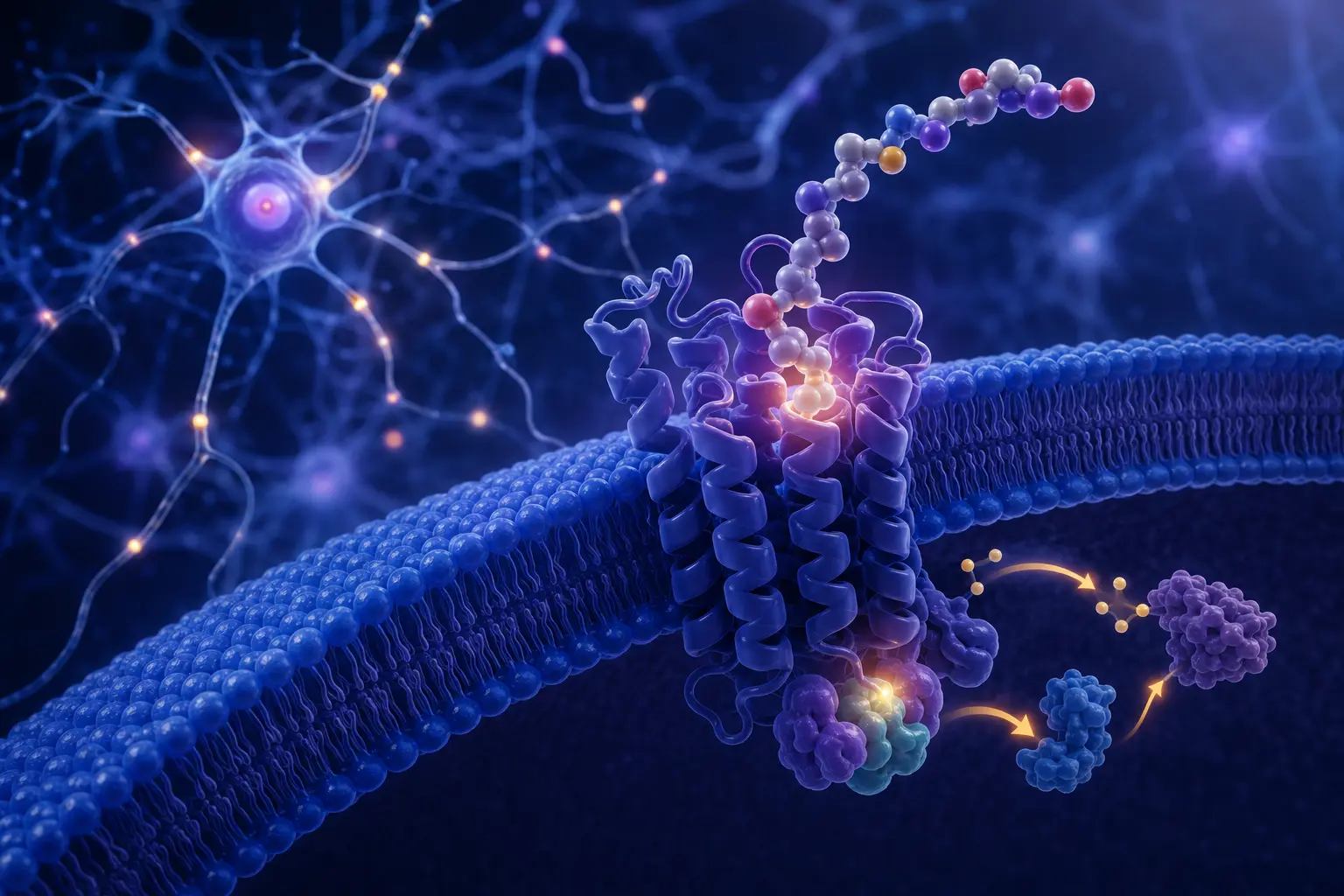
PT-141, known generically as bremelanotide and marketed under the brand name Vyleesi, is a synthetic cyclic heptapeptide that received FDA approval in June 2019 for the treatment of hypoactive sexual desire disorder (HSDD) in premenopausal women. It represents an unusual case in peptide research: a compound that transitioned from early research and body modification subcultures into a formally approved pharmaceutical.
Its development trajectory illustrates both how peptide drugs are developed and how the regulatory pathway works.
The Melanocortin System
Bremelanotide is a melanocortin receptor agonist. The melanocortin system comprises a family of five receptors (MC1R–MC5R) activated by endogenous melanocortin peptides derived from pro-opiomelanocortin (POMC), primarily α-MSH (alpha-melanocyte-stimulating hormone) and ACTH.
Each receptor has a distinct tissue distribution and functional role:
| Receptor | Primary Location | Functions Under Study |
|---|---|---|
| MC1R | Melanocytes, immune cells | Pigmentation, inflammation |
| MC2R | Adrenal cortex | Cortisol production (ACTH receptor) |
| MC3R | Hypothalamus, gut | Energy balance, feeding |
| MC4R | Hypothalamus, CNS | Energy homeostasis, sexual function |
| MC5R | Exocrine glands, peripheral tissues | Sebaceous gland function |
Bremelanotide has activity at MC1R, MC3R, MC4R, and MC5R, but the mechanism believed to underlie its approved indication involves primarily MC4R, which is expressed in brain regions involved in sexual response.
From Melanotan to Bremelanotide
The development story begins with Melanotan I and Melanotan II — synthetic α-MSH analogs developed at the University of Arizona beginning in the 1980s by Mac Hadley, Victor Hruby, and colleagues. These compounds were originally studied for their tanning-promoting effects (MC1R stimulation of melanocyte melanin production) as potential alternatives to UV-induced tanning.
During human studies of Melanotan II, researchers and study participants observed unexpected erections in male subjects. This off-target observation led to investigation of melanocortin stimulation as a potential treatment for sexual dysfunction.
Melanotan II itself has been circulated as an unregistered research compound online and is not an approved drug. Bremelanotide (PT-141) is a derivative with a modified structure: it is a cyclic form missing the C-terminal amide of Melanotan II, which altered its potency and side effect profile, and it was specifically developed for clinical use.
Clinical Development
Readers interested in the broader history of this research space may also want to read Melanotan II: Research, Risks, and Regulatory Status, which traces the earlier melanocortin work that helped motivate later clinical development.
Palatin Technologies conducted the clinical program for bremelanotide:
Phase I trials established safety, tolerability, and pharmacokinetics in healthy volunteers. Early subcutaneous formulations were associated with transient blood pressure increases, which shaped the development of a lower-dose intranasal formulation initially pursued before the final subcutaneous formulation was developed.
Phase II trials examined efficacy in women with HSDD and men with erectile dysfunction. The male ED indication was not pursued to Phase III.
Phase III trials (RECONNECT program) — two identically designed double-blind, placebo-controlled trials — enrolled premenopausal women with HSDD and measured:
- Change in satisfying sexual events (SSEs) per month
- Change in Female Sexual Distress Scale-Desire/Arousal/Orgasm (FSDS-DAO) score
Both trials met their co-primary endpoints, showing statistically significant improvements vs. placebo in both SSEs and distress score. The effect sizes were modest: in pooled data, approximately 0.5 more satisfying sexual events per month compared to placebo, and the proportion of patients achieving a clinically meaningful improvement ranged from about 25% (bremelanotide) vs. 17% (placebo).
FDA Approval and Labeling
Bremelanotide was approved in 2019 as a subcutaneous injection given on demand (at least 45 minutes before anticipated sexual activity). The label includes:
- A black box warning about blood pressure (transient increases)
- Limitations on frequency of use (one dose per 24 hours, no more than one per occasion)
- Approved only for premenopausal women with HSDD
The approval of bremelanotide is notable for the peptide research community because it represents a successful full regulatory pathway: pre-clinical research → Phase I safety → Phase II efficacy signal → Phase III pivotal trials → FDA review → approved drug with a label.
What This Trajectory Illustrates
Bremelanotide's development from university research compound to approved drug took approximately 30 years from initial α-MSH analog work to FDA approval. The path required:
- Identification of a commercial indication distinct from the original tanning research
- Reformulation to address safety concerns discovered in early human trials
- Investment in two well-designed Phase III trials
- Acceptance of modest effect sizes as clinically meaningful
This timeline and complexity are typical of peptide drug development, not exceptional. Researchers who encounter claims that any peptide has been "proven effective" should ask whether they mean proven by this standard — rigorous controlled trials with regulatory review — or by a much lower standard.
References
- 1.Kingsberg SA, Clayton AH, Portman D, Williams LA, Krop J, Jordan R, Lucas J, Sand M. “Bremelanotide for the Treatment of Hypoactive Sexual Desire Disorder: Two Randomized Phase 3 Trials.” Obstetrics and Gynecology. 2019;134(5):899-908. doi:10.1097/AOG.0000000000003500 [PubMed]
- 2.Hadley ME, Dorr RT. “Melanocortin peptide therapeutics: historical milestones, clinical studies and commercialization.” Peptides. 2006;27(4):921-930. doi:10.1016/j.peptides.2005.01.029 [PubMed]
- 3.U.S. Food and Drug Administration. “FDA approves new treatment for hypoactive sexual desire disorder in premenopausal women.” 2019. [Link]