Selank: Research on an Anxiolytic Peptide Analog
Selank research review: a synthetic tuftsin-derived heptapeptide studied for anxiolytic and cognitive effects, covering mechanisms and clinical evidence.
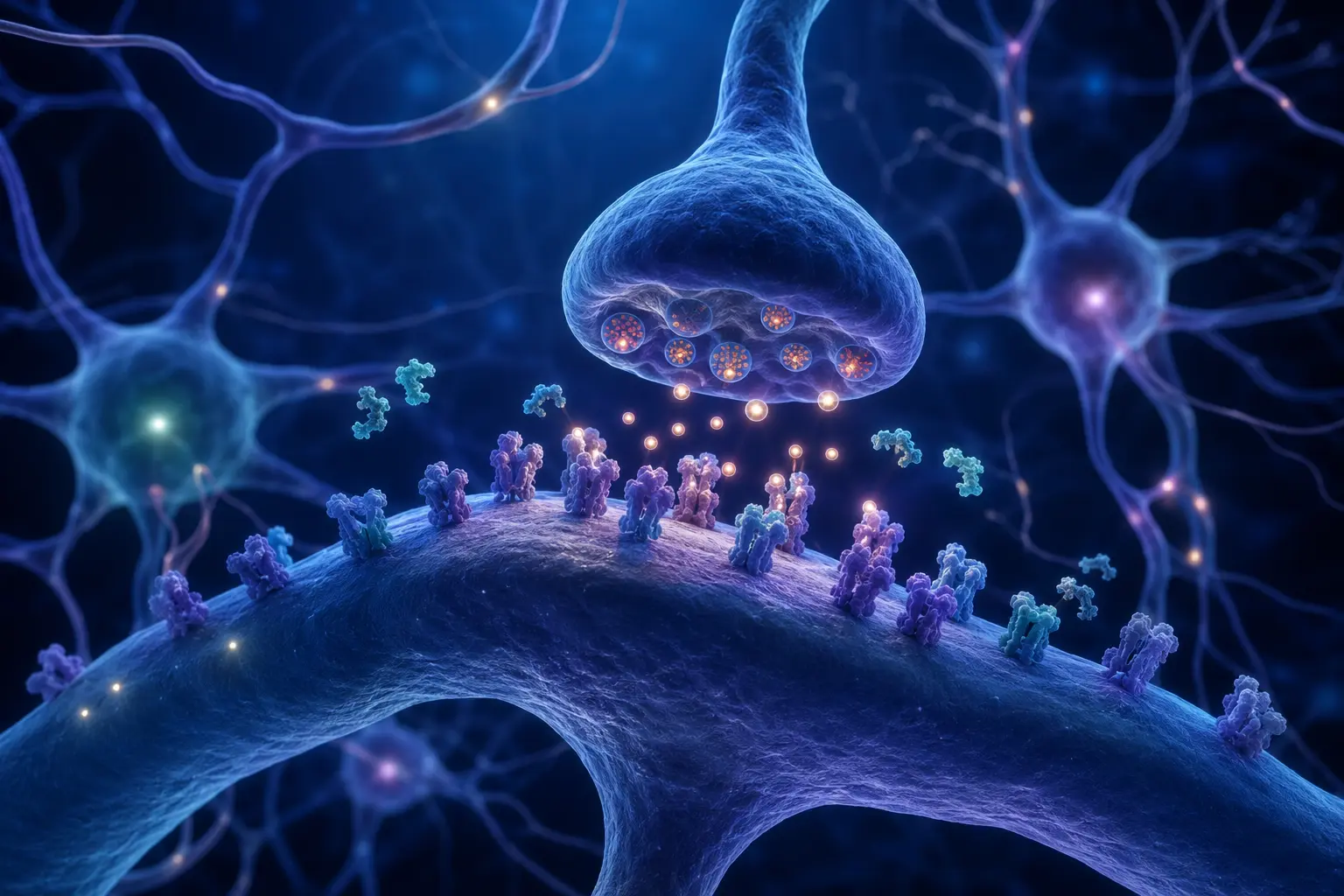
Selank (Селанк in Russian) is a synthetic heptapeptide with the sequence Thr-Lys-Pro-Arg-Pro-Gly-Pro. It was developed at the Institute of Molecular Genetics of the Russian Academy of Sciences as an analog of tuftsin, a naturally occurring tetrapeptide (Thr-Lys-Pro-Arg) derived from the Fc region of IgG immunoglobulin.
Selank extends the tuftsin sequence with an additional Pro-Gly-Pro tripeptide, a modification researchers reported improves stability and alters the compound's activity profile relative to native tuftsin.
Tuftsin: The Parent Peptide
For broader context on how neuropeptides function as signaling molecules in the nervous system, see our overview of the neuropeptide class. Tuftsin was originally characterized as an immunostimulatory peptide, with research examining its effects on macrophage and neutrophil activation. Later research also explored potential anxiolytic and cognitive effects in animal models.
Tuftsin itself has poor pharmacokinetic properties — it is rapidly degraded by plasma peptidases — which motivated the development of more stable analogs like Selank.
Neurobiological Mechanisms Under Study
Research on Selank has focused on several proposed mechanisms, primarily in animal models:
GABAergic system interaction: Some researchers have proposed that Selank may modulate GABA-A receptor function, which would provide a mechanistic basis for the anxiolytic-like behaviors observed in rodent models. The specific interaction has been characterized in some cell and animal studies, though the findings are not universally replicated.
BDNF and neurotrophin effects: A subset of studies has examined whether Selank may influence brain-derived neurotrophic factor (BDNF) expression in rodent brain regions associated with anxiety and memory. BDNF plays established roles in synaptic plasticity and neuronal survival, making this a biologically plausible area of investigation.
Enkephalin degradation inhibition: Some earlier research proposed that Selank may inhibit enzymes responsible for degrading enkephalins (endogenous opioid peptides), potentially extending their signaling duration. This mechanism has been discussed but not definitively established.
Immune-related activity: Consistent with its tuftsin lineage, some research has examined whether Selank may influence immune cell activity, cytokine profiles, or inflammatory markers in animal models.
Behavioral Studies in Animals
Rodent studies have used standard behavioral models to examine potential anxiolytic-like properties of Selank:
- Elevated plus maze (EPM): Measures preference for open vs. enclosed arms as a proxy for anxiety-like behavior. Some studies have reported that Selank-treated animals may spend more time in open arms, suggesting anxiolytic-like effects.
- Open field test: Measures locomotor activity and center exploration. Some studies have reported increased center time in treated animals without significant changes in total locomotion, which is considered consistent with an anxiolytic rather than sedative profile.
- Conflict tests: Various Vogel-type conflict paradigms have been used.
These behavioral readouts are established in pharmacological research but have known limitations in translating to human anxiety states.
Russian Clinical Research
Selank has been approved as a pharmaceutical drug in Russia and Ukraine for the treatment of anxiety disorders and as a nootropic agent. The clinical approval is based on research conducted primarily by Russian institutions, including the Institute of Molecular Genetics and research centers affiliated with the Russian Academy of Medical Sciences.
Published Russian clinical studies have examined Selank in generalized anxiety disorder (GAD) and asthenic conditions. These studies have generally reported positive outcomes on anxiety rating scales. However, critical evaluation requires noting:
- Most are small trials (often n < 100)
- Independent replication by international groups outside Russia is limited
- Some trials lack adequate placebo controls or blinding described in the publications
- The regulatory approval pathway in Russia differs substantially from FDA or EMA standards
Administration and Pharmacokinetics
Selank has been most commonly studied via intranasal administration in Russian clinical research, with nasal drops being the marketed pharmaceutical form. This route is used specifically because the blood-brain barrier presents a significant obstacle to systemic peptide delivery.
The plasma half-life of Selank is short — intranasal administration is proposed to allow some direct delivery to CNS tissue via the olfactory mucosa pathway, bypassing the need for systemic circulation. The extent of this olfactory pathway delivery in humans is not fully quantified in published pharmacokinetic studies.
Evaluating the Evidence
Researchers interested in Selank should approach the literature with awareness that:
- The majority of clinical research comes from a single country and limited number of institutions — for a framework on evaluating such evidence, see Evaluating Peptide Research Claims.
- Regulatory approval in Russia does not constitute independent validation
- The proposed mechanisms are biologically plausible but not definitively established in rigorous human studies
- There is no published Phase III RCT from an independently funded international research program
The compound remains a legitimate subject of neuropharmacological research, but claims that extrapolate beyond what the existing evidence shows should be evaluated critically.
For context on how Selank fits within the broader landscape of neuropeptide research, see Neuropeptides: An Introduction to Peptides in the Nervous System.
References
- 1.Semenova TP, Kozlovskaya MM, Zakharova NM, Kozlovskii II. “Correction of exploratory behavior and memory in rats with the peptide anxiolytic selank.” Bulletin of Experimental Biology and Medicine. 2010;150(3):374-376 [PubMed]
- 2.Uchakina ON, Uchakin PN, Miasoedov NF, Andreeva LA, Shcherbenko VE, Mezentseva MV, Gabaeva MV, Sokolov OIu, Zozulia AA, Ershov FI. “Immunomodulatory effects of selank in patients with anxiety-asthenic disorders.” Zhurnal Nevrologii i Psikhiatrii Imeni S.S. Korsakova. 2008;108(5):71-75 [PubMed]