Epitalon (Epithalon): Telomere Research, Evidence, and FDA Status
A critical review of Epitalon (Epithalon), including telomere and sleep research, evidence limitations, safety questions, and July 2026 FDA status.
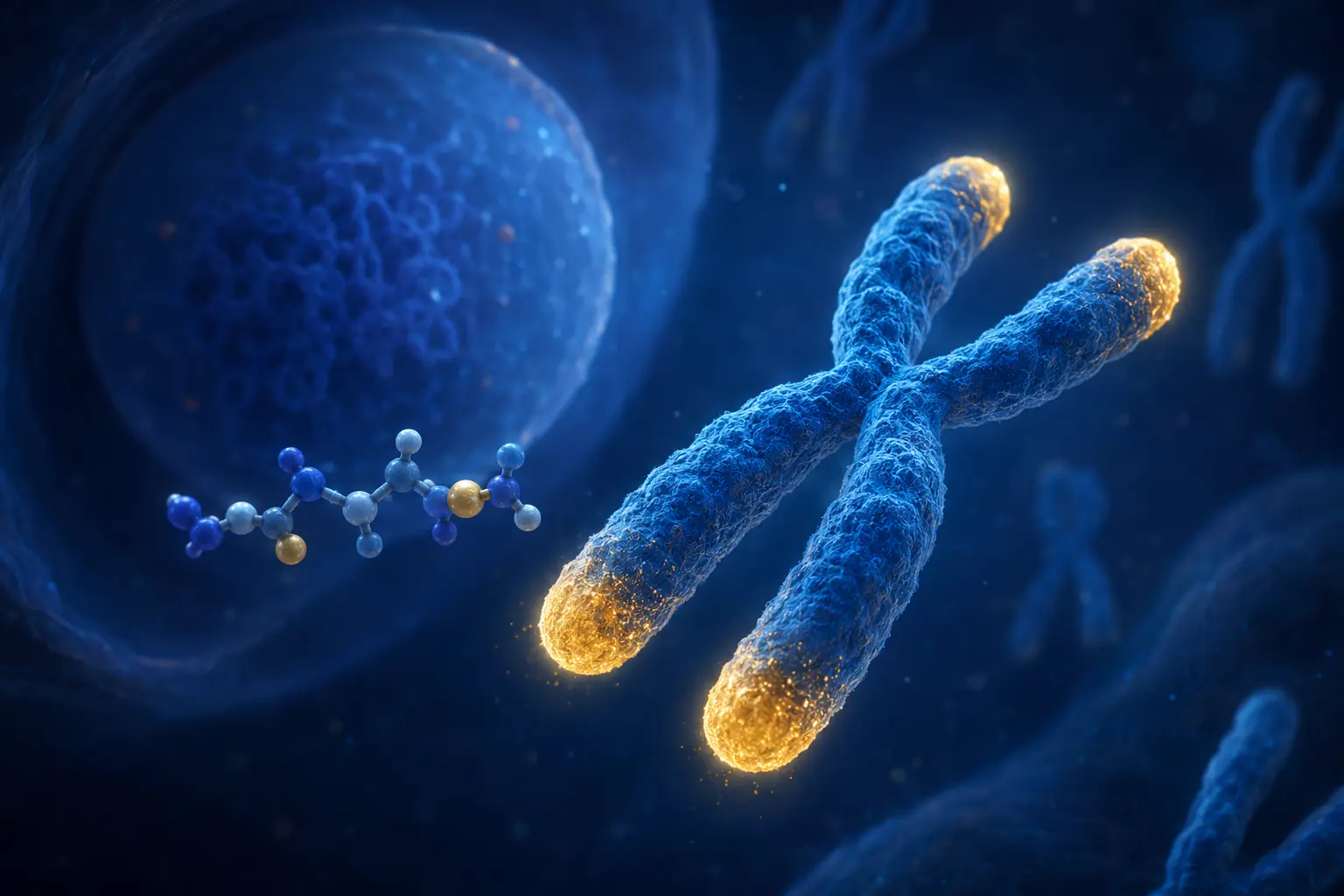
Epithalon (also spelled Epitalon) is a synthetic tetrapeptide with the sequence Ala-Glu-Asp-Gly. It is a synthetic analog of epithalamin, a polypeptide complex extracted from bovine pineal gland tissue that was studied extensively by Vladimir Khavinson and colleagues at the St. Petersburg Institute of Bioregulation and Gerontology beginning in the 1980s.
The research program that produced Epithalon represents an unusual body of work in gerontology — largely conducted by a single research group, published predominantly in Russian-language journals and Eastern European venues, with limited independent international replication. Understanding this provenance is essential for evaluating the claims made about this compound.
The Telomere Hypothesis
The primary mechanism proposed for Epithalon's studied effects involves telomerase activation. Telomeres are repetitive DNA sequences (TTAGGG in humans) that cap chromosomal ends and shorten with each cell division. Critically short telomeres trigger cellular senescence or apoptosis. Telomerase is the enzyme that can extend telomere sequences, and its activity is normally restricted in differentiated somatic cells.
Researchers from the Khavinson group have reported in cell culture experiments that Epithalon may activate telomerase in human fetal fibroblasts and some other cell lines, potentially allowing cells to maintain longer telomere length over successive divisions. This is the mechanistic basis for the anti-aging claims associated with the peptide.
Important caveat: Telomerase activation is a double-edged biological phenomenon. Sustained telomerase upregulation in somatic cells is also a hallmark of cancer cell immortality. Research into therapeutic telomerase modulation must address this oncogenic risk, and the studies on Epithalon have not adequately characterized this consideration.
Animal Longevity Studies
The Khavinson group has published a series of animal studies — primarily in mice and rats — reporting that animals receiving Epithalon (or the parent compound epithalamin) over their lifetimes showed extended median and maximum lifespan compared to controls. Some studies also reported reduced tumor incidence in treated animals.
These studies face several methodological considerations:
- They originate from a single research group with potential investigator bias
- They have not been replicated by independent research groups in peer-reviewed publications
- Animal longevity studies, even well-designed ones, have poor translation to human aging interventions historically
- The control conditions and blinding procedures in older studies from this group are not always clearly described in the published reports
Human Observations
A small number of clinical observations have been published by the same research group, reporting on parameters such as circadian rhythm restoration, immune markers, and functional outcomes in elderly subjects. These are observational in nature, with small sample sizes, and do not meet the standard of a properly controlled clinical trial.
No randomized controlled trial of Epithalon in humans meeting contemporary standards of clinical research has been published as of this writing.
The Pineal Gland Connection
The original interest in pineal peptides was connected to the role of melatonin and pineal-derived factors in circadian biology and aging. The pineal gland's role in regulating circadian rhythms through melatonin is well-established. Whether pineal peptide extracts have bioregulatory effects beyond melatonin's actions is a hypothesis that the Khavinson group pursued extensively but that has not been validated by mainstream gerontology research.
Structural Considerations
Epithalon (Ala-Glu-Asp-Gly) is a tetrapeptide small enough to potentially be orally bioavailable to some degree, depending on GI peptidase activity and transit. However, this has not been formally characterized in published pharmacokinetic studies. Most research protocols have used subcutaneous or intranasal administration.
The plasma half-life of such a small peptide would be expected to be short without structural modifications (similar to other unmodified small peptides), though this has not been rigorously reported.
July 2026 FDA PCAC Outcome
FDA uses the spelling Epitalon in its 2026 compounding review and evaluated Epitalon free base and Epitalon acetate for possible inclusion on the Section 503A Bulks List. The use FDA evaluated was insomnia—not longevity, telomere extension, or anti-aging. [3]
FDA reported no clinical data supporting the safety of either reviewed form in humans, particularly for the proposed subcutaneous route. The agency also identified incomplete physical and chemical characterization, limited historical compounding information, insufficient effectiveness evidence for insomnia, and potential concerns involving impurities, aggregation, and immunogenicity. Staff concluded that the balance weighed against listing. [3]
On July 24, 2026, PCAC voted 7–5, with one abstention, to recommend inclusion of the Epitalon-related group. The recommendation is nonbinding, does not make Epitalon FDA approved, and does not itself establish an anti-aging or telomere-related indication. FDA final action remains pending. [4]
See the FDA PCAC peptide review hub for the full vote table and next steps.
Evaluating the Evidence
The honest summary of the Epithalon research base is:
- There is in vitro data from a single group suggesting telomerase activity in cell lines. For a framework on evaluating single-source evidence, see Evaluating Peptide Research Claims.
- There are animal studies from the same group with longevity-related outcomes
- There is a small body of human observational data from the same group
- There is no published independent replication in a major international research program
- There are no published randomized controlled trials
Researchers interested in telomere biology and aging should also familiarize themselves with the broader field, which includes work on telomere length as a biomarker, TERT gene studies in model organisms, and the complex relationship between telomerase activation and cancer risk.
Frequently Asked Questions
Are Epitalon and Epithalon the same peptide?
The names are commonly used for the same Ala-Glu-Asp-Gly tetrapeptide. FDA's July 2026 documents use “Epitalon.” Exact chemical form and identity should still be verified.
Has Epitalon been shown to extend human lifespan?
No controlled human trial has established lifespan extension. Much of the longevity literature comes from one research program and has limited independent replication.
Is Epitalon FDA approved?
No. FDA is reviewing its free-base and acetate forms for the 503A Bulks List, not considering a new drug application.
References
- 1.Khavinson VKh, Bondarev IE, Butyugov AA. “Epithalon peptide induces telomerase activity and telomere elongation in human somatic cells.” Bulletin of Experimental Biology and Medicine. 2003;135(6):590-592 [PubMed]
- 2.Khavinson V, Diomede F, Mironova E, Linkova N, Trofimova S, Trubiani O, Caputi S, Sinjari B. “AEDG Peptide (Epitalon) Stimulates Gene Expression and Differentiation of Rat Embryonic Stem Cells into Neuronal Direction.” Molecules. 2020;25(3). doi:10.3390/molecules25030609 [PubMed]
- 3.U.S. Food and Drug Administration. “FDA Briefing Document for Epitalon-Related Bulk Drug Substances.” 2026. [Link]
- 4.Eglovitch JS. “FDA advisory committee backs two more peptides, rejects one for compounding list.” Regulatory Focus, Regulatory Affairs Professionals Society. 2026. [Link]