Hexarelin: The Most Potent GHRP and Its Cardiac Research
Hexarelin research: the most potent synthetic GHRP, covering GH-releasing mechanism, cardiac receptor activity, and cardiovascular research findings.
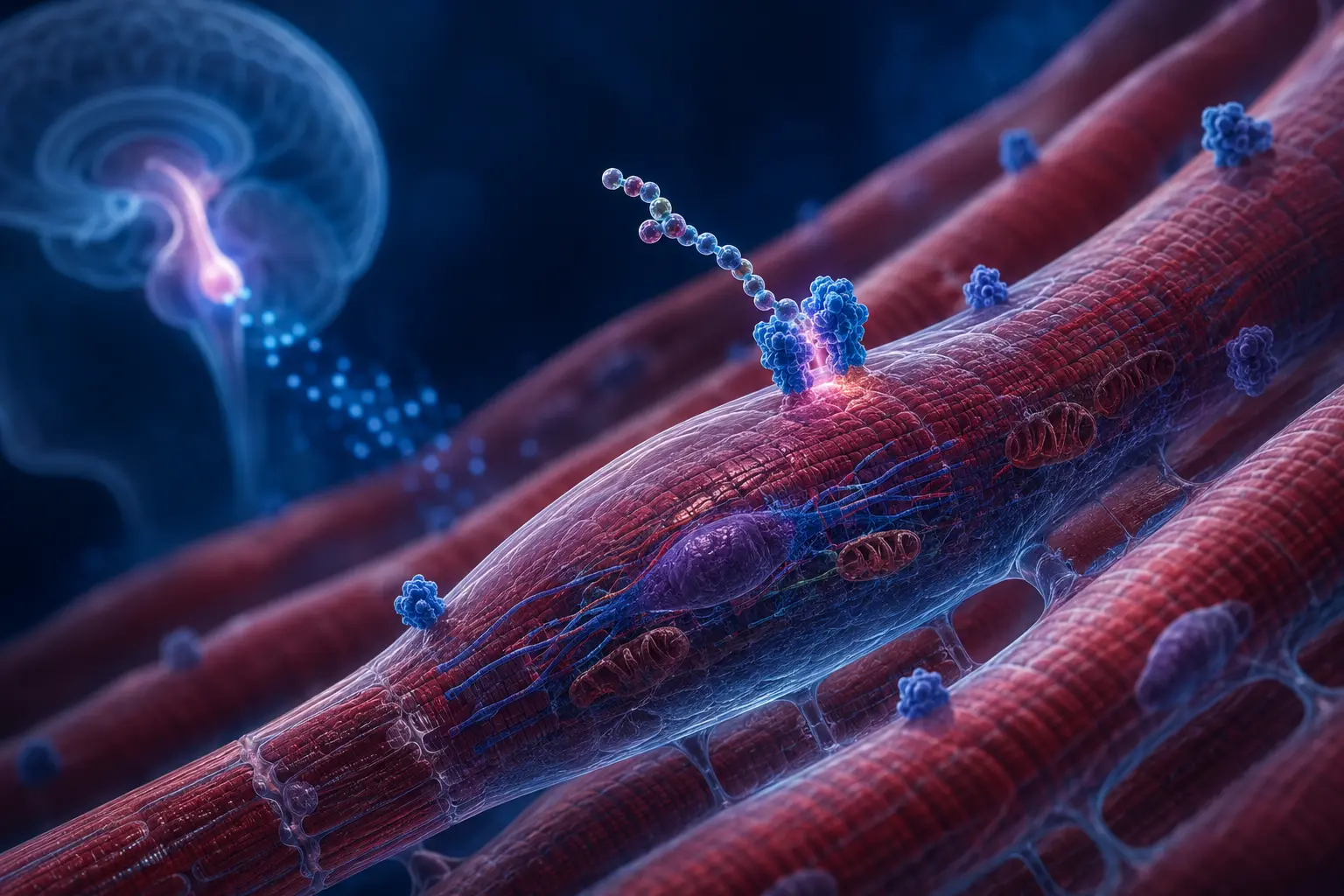
Hexarelin is a synthetic hexapeptide GHS with the sequence His-D-2MeTrp-Ala-Trp-D-Phe-Lys-NH₂. It is structurally related to GHRP-6 but incorporates a 2-methyltryptophan residue in the D configuration at position 2, which significantly enhances its potency at the GHS-R1a receptor.
Hexarelin has been characterized as the most potent synthetic GHRP in terms of GH-releasing activity, but it has also attracted research interest for reasons entirely unrelated to growth hormone: its activity at CD36, a multifunctional scavenger receptor expressed on heart muscle cells.
GH-Releasing Properties
Like other GHRPs, hexarelin stimulates GH release through GHS-R1a agonism. Studies comparing hexarelin to GHRP-6 and GHRP-2 have found that hexarelin may produce greater GH responses at equivalent doses in both animal and human studies.
However, this enhanced potency comes with a less favorable selectivity profile compared to ipamorelin. Human studies have reported that hexarelin administration is associated with significant elevations of cortisol and prolactin, which are considered off-target effects for researchers primarily interested in GH axis pharmacology.
Additionally, some human studies have reported that repeated hexarelin administration may be associated with a diminishing GH response over time — a desensitization or tachyphylaxis effect not clearly observed with other GHSPs at typical research doses. The mechanism has been attributed to GHS-R1a downregulation or desensitization at higher receptor occupancy levels.
The CD36 Discovery
In the late 1990s and early 2000s, Italian researchers at the University of Milan, particularly the group of Ezio Ghigo and Mauro Maccario, along with Emanuela Muccioli, identified that hexarelin and some related compounds bind to CD36 — a receptor with a completely different structure and function from GHS-R1a.
CD36 (also known as fatty acid translocase) is a scavenger receptor expressed on platelets, monocytes/macrophages, adipocytes, and cardiomyocytes. It plays roles in fatty acid uptake, lipid metabolism, and angiogenesis inhibition. Importantly, CD36 is expressed at high levels in the heart.
Binding studies showed that hexarelin binds CD36 with measurable affinity, and that some cardioprotective effects observed in animal studies with hexarelin may be attributable to CD36 activity rather than GHS-R1a activity. This was demonstrated using GHS-R1a-deficient animal models that still showed cardiac responses to hexarelin — an approach that provided receptor specificity evidence.
Cardiac Research
The identification of CD36 as a hexarelin binding target opened a distinct research line:
Ischemia-reperfusion models: Animal studies have examined whether hexarelin administration before or after induced cardiac ischemia-reperfusion injury may influence myocardial survival markers. Some studies have reported reduced infarct size and improved cardiac function parameters in treated animals.
Cardiac function in GH-deficient models: Some animal studies in GH-deficient models have reported improvements in cardiac contractility with hexarelin, though separating GH-axis effects from direct cardiac effects requires careful design.
Proposed CD36-mediated mechanisms: Researchers have examined hexarelin's effects on gene expression in cardiomyocytes, with some studies reporting changes in proteins involved in calcium handling and contractile function.
Significance for the GHS Field
The hexarelin/CD36 story has implications beyond this specific compound:
-
Multiple receptor systems: It demonstrates that the same synthetic peptide can have mechanistically distinct effects through different receptors in different tissues. Attributing all effects of a compound to its primary characterized receptor target may be incorrect.
-
Unexpected findings drive science: The cardiac observations were an off-target discovery that led to a productive research direction separate from the original GH focus.
-
Species differences matter: The extent to which CD36-mediated effects translate from rodent models to humans has not been characterized.
Human Research on Hexarelin
Several human studies from the 1990s established the pharmacodynamic profile of hexarelin for GH release. These are among the more well-characterized in the GHS literature in terms of human data. However, the specific cardiac applications suggested by the CD36 research have not been translated into human clinical trials as of this writing.
The combination of high potency, off-target steroidogenic effects, and tachyphylaxis potential has made hexarelin less attractive for prolonged research use compared to more selective GHSs, despite its historical significance in characterizing the GHS receptor system.
References
- 1.Arvat E, Maccario M, Di Vito L, Broglio F, Boghen MF, Deghenghi R, Camanni F, Ghigo E. “Endocrine activities of ghrelin, a natural growth hormone secretagogue (GHS), in humans: comparison and interactions with hexarelin, a nonnatural peptidyl GHS, and GH-releasing hormone.” Journal of Clinical Endocrinology and Metabolism. 2001;86(3):1169-1174. doi:10.1210/jcem.86.3.7293 [PubMed]
- 2.Muccioli G, Ghe C, Ghigo MC, Papotti M, Arvat E, Boghen MF, Deghenghi R, Camanni F, Ghigo E. “Specific receptors for synthetic GH secretagogues in the human brain and pituitary gland.” Journal of Endocrinology. 1998;157(1):99-106. doi:10.1677/joe.0.1570099 [PubMed]
- 3.Tschop M, Smiley DL, Heiman ML. “Ghrelin induces adiposity in rodents.” Nature. 2000;407(6806):908-913. doi:10.1038/35038090 [PubMed]