Ipamorelin vs CJC-1295: Different Roles in Growth Hormone Research
Ipamorelin and CJC-1295 act on different receptors in the growth hormone pathway. This comparison covers their mechanisms, evidence bases, and why they are often studied together.
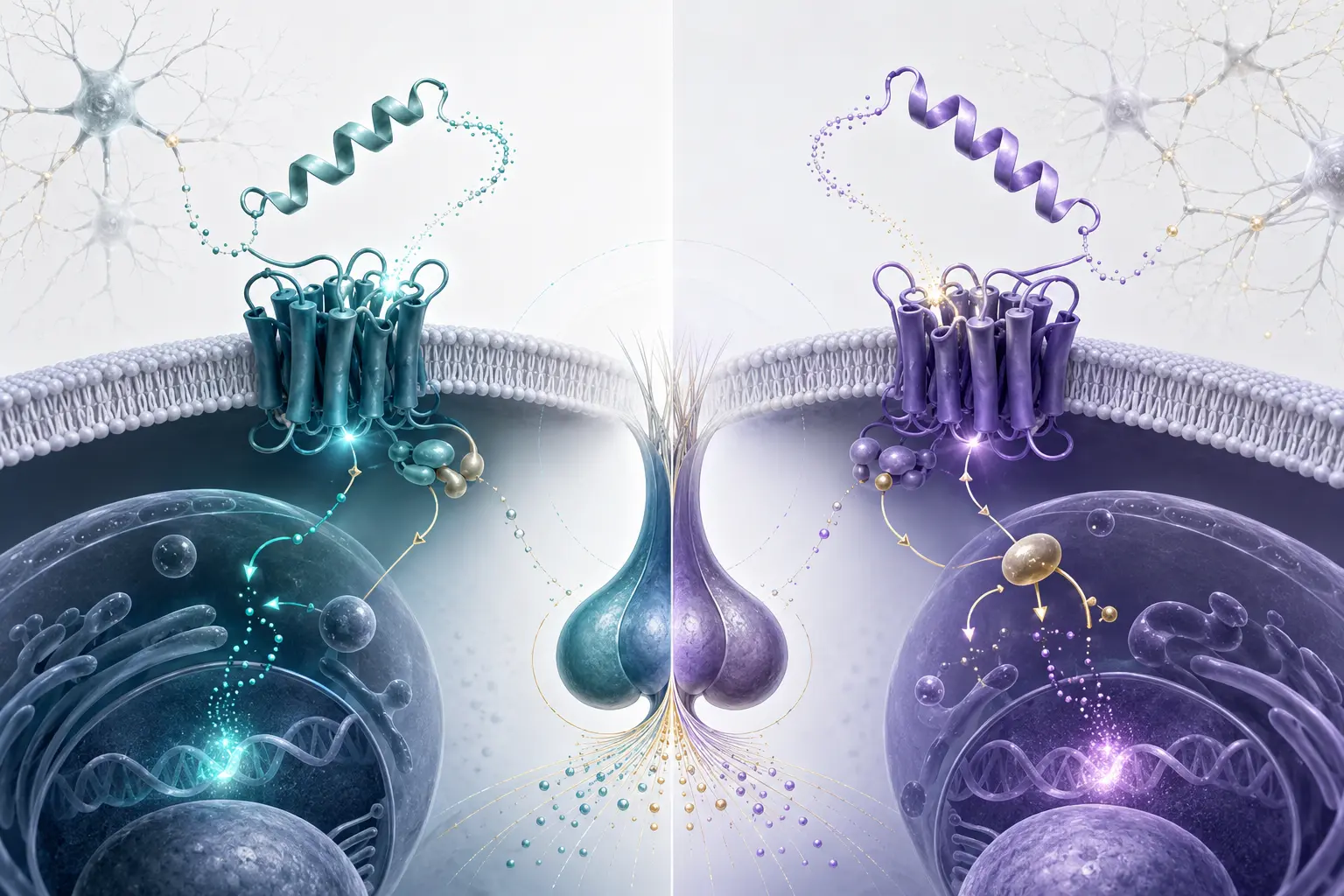
Ipamorelin and CJC-1295 are commonly discussed together, and often combined in research protocols, because they target two different receptors in the same growth hormone release pathway. This is a comparison of two mechanistically complementary — not competing — compounds.
Quick answer: Ipamorelin is a growth hormone secretagogue receptor (GHS-R1a) agonist, structurally a pentapeptide, studied for its receptor selectivity relative to older GHRP compounds. CJC-1295 is a GHRH (growth hormone-releasing hormone) receptor agonist, structurally a modified 29-44 amino acid GHRH analog with an extended half-life via albumin binding. They act on different receptors upstream of the same downstream event — pituitary growth hormone release — which is why they are often studied in combination rather than as alternatives to one another.
Key Differences
| Ipamorelin | CJC-1295 | |
|---|---|---|
| Receptor target | GHS-R1a (ghrelin receptor) | GHRH receptor |
| Structure | Pentapeptide (5 amino acids) | GHRH analog (29-44 amino acids), DAC-modified |
| Half-life | Short (minutes) | Long (days, via albumin binding) |
| Key published study | Raun et al., 1998[] | Teichman et al., 2006[] |
| Distinguishing research focus | Receptor selectivity vs. older GHRPs | Pharmacokinetics and sustained GH/IGF-1 elevation |
Mechanisms
Ipamorelin activates the growth hormone secretagogue receptor, the same receptor targeted by endogenous ghrelin. Its research significance lies substantially in its selectivity: earlier GHS-class peptides such as GHRP-6 were observed to also stimulate prolactin, ACTH, and cortisol release, while Raun and colleagues' original characterization found ipamorelin had much higher relative selectivity for GHS-R1a with less effect on these other hormones at equipotent GH-releasing doses.[]
CJC-1295 works upstream through an entirely different receptor — the GHRH receptor on pituitary somatotrophs — mimicking the action of native growth hormone-releasing hormone. Its key research contribution is pharmacokinetic rather than receptor-selective: native GHRH has a plasma half-life of only 6-8 minutes due to DPP-4 cleavage, while CJC-1295's Drug Affinity Complex (DAC) technology covalently binds it to serum albumin after injection, extending its effective half-life to days rather than minutes.[]
Because ipamorelin (GHS-R1a) and CJC-1295 (GHRH receptor) act through distinct receptors on the same pituitary somatotroph, clinical endocrinology literature has separately used GHRH and GHRP-class secretagogues as complementary diagnostic tools for GH deficiency — reflecting the same two-receptor logic that underlies why the compounds are often studied together.[]
Evidence Level Comparison
Both compounds have published, peer-reviewed human data — a distinguishing feature relative to many research peptides, most of which have only animal-model literature. Ipamorelin's core evidence is the original 1998 Novo Nordisk characterization study, which included human and animal receptor-binding and hormone-release data.[] CJC-1295's core evidence is a 2006 published Phase I/II human clinical trial measuring sustained GH and IGF-1 elevation over multiple weeks.[] Neither compound has extensive modern (post-2010) human trial literature; both evidence bases are dated relative to more recently developed compounds.
Human Trial Results
The CJC-1295 trial reported sustained elevation of GH and IGF-1 levels for multiple weeks following dosing, a notably long duration of effect attributable to its albumin-binding pharmacokinetics.[] Ipamorelin's human data, from the original characterization work, focused on acute GH-release response and selectivity relative to cortisol, ACTH, and prolactin rather than long-duration IGF-1 elevation.[] Because the two studies measured different endpoints (acute selectivity vs. sustained hormone elevation), they are not directly comparable head-to-head — they characterize different aspects of the growth hormone axis.
Safety Findings
Ipamorelin's principal safety-relevant research finding is its comparatively narrow off-target hormonal effect relative to older GHRPs, based on the cortisol/ACTH/prolactin comparisons in the original characterization study.[] CJC-1295's DAC-based albumin binding raises a mechanism-specific consideration distinct from ipamorelin: because its effects are sustained over days rather than minutes, any adverse effects from excess GH/IGF-1 elevation would also be expected to persist longer than with a short-acting secretagogue.
Regulatory and Approval Status
Neither ipamorelin nor CJC-1295 holds FDA approval for human use. Both are classified as research chemicals, not approved growth hormone therapies or dietary supplements.
Research Limitations
Because ipamorelin and CJC-1295 act on different receptors in the same axis, much of the research interest in combining them is mechanistic reasoning (complementary receptor targets) rather than direct evidence from a combined-compound clinical trial. Readers should be aware that most claims about the effects of the two compounds in combination extend beyond what either individual compound's published clinical trial data directly demonstrates. See Growth Hormone Secretagogues Overview for broader context on this compound class.
References
- 1.Raun K, Hansen BS, Johansen NL, Thogersen H, Madsen K, Ankersen M, Andersen PH. “Ipamorelin, the first selective growth hormone secretagogue.” European Journal of Endocrinology. 1998;139(5):552-561. doi:10.1530/eje.0.1390552 [PubMed]
- 2.Teichman SL, Neale A, Lawrence B, Gagnon C, Castaigne JP, Frohman LA. “Prolonged stimulation of growth hormone (GH) and insulin-like growth factor I secretion by CJC-1295, a long-acting analog of GH-releasing hormone, in healthy adults.” Journal of Clinical Endocrinology and Metabolism. 2006;91(3):799-805. doi:10.1210/jc.2005-1536 [PubMed]
- 3.Popovic V, Leal A, Micic D, Koppeschaar HP, Torres E, Paramo C, Obradovic S, Dieguez C, Casanueva FF. “GH-releasing hormone and GH-releasing peptide-6 for diagnostic testing in GH-deficient adults.” Lancet. 2000;356(9236):1137-1142. doi:10.1016/S0140-6736(00)02745-0 [PubMed]