BPC-157 vs TB-500: Mechanisms, Evidence, and Research Limitations
BPC-157 and TB-500 are both studied for tissue repair, but through different molecular mechanisms and with different evidence bases. A side-by-side research comparison.
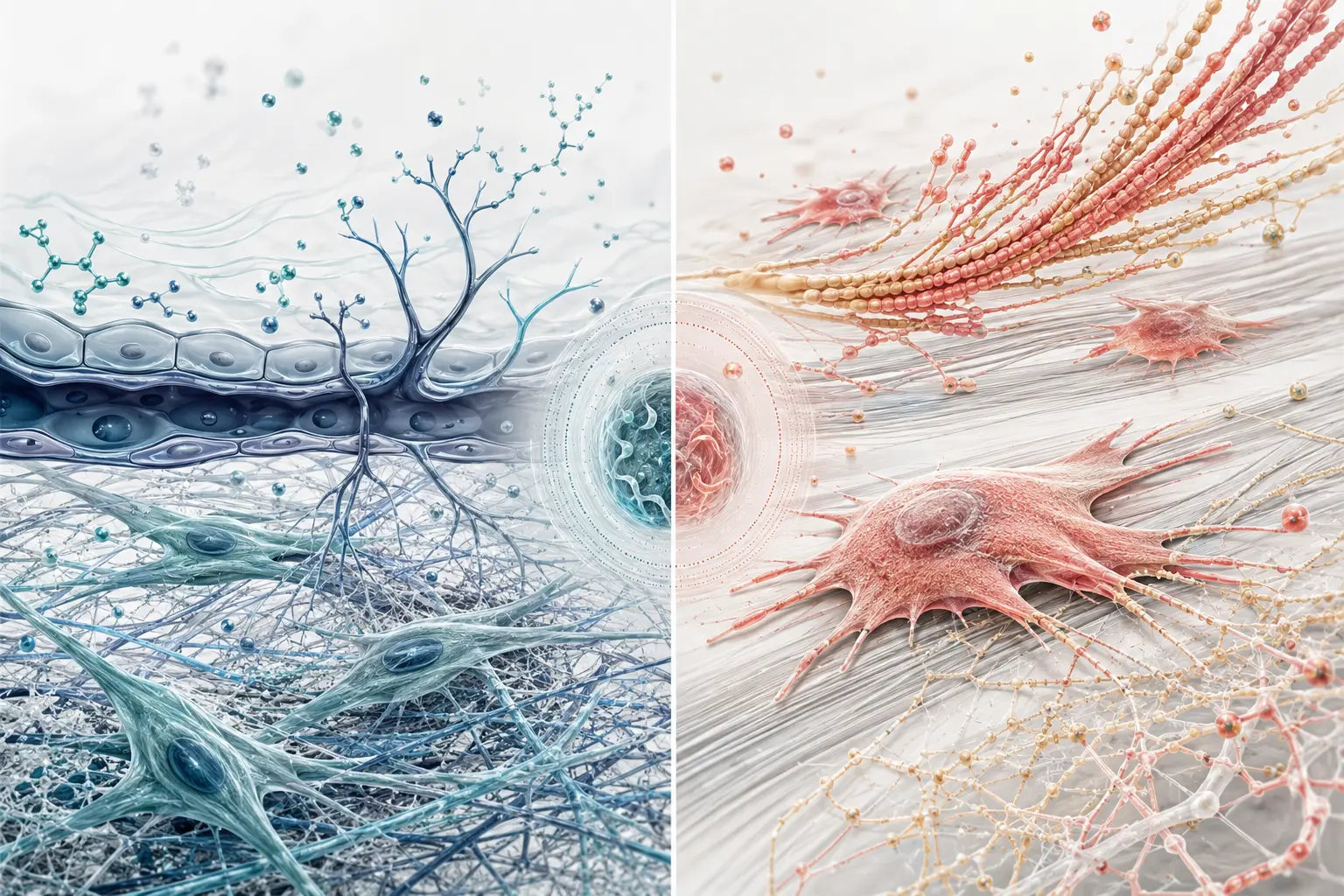
Researchers interested in tissue repair often encounter BPC-157 and TB-500 together, since both are studied in the context of wound healing and connective tissue recovery. They are structurally and mechanistically unrelated compounds, however, and the research supporting each differs in important ways.
Quick Answer
BPC-157 is a synthetic 15-amino-acid peptide fragment derived from a protein in human gastric juice, studied mainly for gastrointestinal and musculoskeletal tissue effects. TB-500 is the name commonly used for research versions of Thymosin Beta-4, a naturally occurring 43-amino-acid protein involved in actin regulation and cell migration. Neither compound is FDA-approved for human use, and both are studied almost exclusively in cell culture and animal models rather than human trials.
Key Differences
| BPC-157 | TB-500 (Thymosin Beta-4) | |
|---|---|---|
| Origin | Synthetic fragment of a gastric protein | Synthetic version of a naturally occurring 43-aa protein |
| Length | 15 amino acids (pentadecapeptide) | 43 amino acids |
| Primary studied mechanism | Angiogenesis promotion, growth factor pathway modulation | Actin sequestration, cell migration, anti-inflammatory signaling |
| Tissue focus in research | GI tract, tendon, ligament, muscle | Cardiac tissue, skin, cornea, muscle |
| Evidence base | Animal models, in vitro; limited human trial data[][] | Animal models, in vitro; cardiac repair models[][] |
Mechanisms
BPC-157's studied mechanism centers on promotion of angiogenesis (new blood vessel formation) at injury sites and modulation of growth factor receptor pathways, including interactions with the VEGF and FAK-paxillin signaling pathways described in musculoskeletal healing models.[] Its effects have also been studied in the context of the "brain-gut axis," reflecting its gastric origin.[]
TB-500's mechanism is different in kind: as a fragment of the naturally occurring Thymosin Beta-4 protein, it acts primarily through actin sequestration — binding monomeric G-actin and regulating the cytoskeletal dynamics that underlie cell migration.[] This actin-regulating role is thought to be central to Thymosin Beta-4's studied effects on cell migration into wound sites, and its investigated role in cardiac cell migration and survival after injury.[][]
Evidence Level Comparison
Both compounds share a similar evidentiary limitation: the large majority of published research is preclinical (in vitro and animal models), with very limited peer-reviewed human clinical trial data for either. BPC-157's literature includes a substantial body of rodent model studies from Croatian researchers spanning several decades, along with some early-phase trials for gastrointestinal indications referenced in review literature.[] TB-500/Thymosin Beta-4 research includes notable work in cardiac repair models in mice[] and broader reviews of its regenerative properties across tissue types.[] Neither compound should be considered clinically validated in humans based on the current published literature.
Laboratory and Animal Evidence
BPC-157 animal studies have examined musculoskeletal soft tissue healing, including tendon-to-bone healing and ligament injury models, with reported acceleration of healing markers relative to controls.[] TB-500/Thymosin Beta-4 animal studies have examined cardiac tissue repair after induced myocardial injury, with reported effects on cell survival and migration into the damaged area.[] Both bodies of evidence are limited by typical translational caveats — animal model results, particularly rodent models, do not reliably predict human clinical outcomes at the same magnitude.
Human Trial Results
Published, peer-reviewed human trial data is sparse for both compounds relative to the amount of animal literature available. Readers should be cautious of secondary sources that describe either compound's effects using language ("proven," "clinically shown") that implies a stronger human evidence base than currently exists in the peer-reviewed literature.
Safety Findings
Neither compound has an FDA-reviewed safety profile in humans. Reported animal-model safety findings are not a substitute for human pharmacovigilance data, and neither compound should be assumed to carry the same safety profile as an approved drug.
Regulatory and Approval Status
Neither BPC-157 nor TB-500 is FDA-approved for any human indication. Both are classified as research chemicals in most jurisdictions, not as dietary supplements or approved therapeutics.
Research Limitations
The comparison above should not be read as establishing relative superiority of one compound over the other — they act through different mechanisms on different aspects of the tissue-repair process and have been studied in substantially different experimental contexts, which limits direct comparison. Anyone evaluating either compound for research purposes should consult the primary literature directly rather than relying on secondary summaries, including this one.
References
- 1.Sikiric P, Seiwerth S, Rucman R, Turkovic B, Rokotov DS, Brcic L, Sever M, Klicek R, Radic B, Drmic D, Ilic S, Kolenc D, Stambolija V, George N, Pavlov KH, Kalogjera L. “Brain-gut Axis and Pentadecapeptide BPC 157: Theoretical and Practical Implications.” Current Neuropharmacology. 2016;14(8):857-865 [PubMed]
- 2.Gwyer D, Wragg NM, Wilson SL. “Gastric pentadecapeptide body protection compound BPC 157 and its role in accelerating musculoskeletal soft tissue healing.” Cell and Tissue Research. 2019;377(2):153-159. doi:10.1007/s00441-019-03016-8 [PubMed]
- 3.Bock-Marquette I, Saxena A, White MD, Dimaio JM, Bhatt DL. “Thymosin beta4 activates integrin-linked kinase and promotes cardiac cell migration, survival and cardiac repair.” Nature. 2004;432(7016):466-472. doi:10.1038/nature03000 [PubMed]
- 4.Goldstein AL, Hannappel E, Sosne G, Kleinman HK. “Thymosin beta4: a multi-functional regenerative peptide. Basic properties and clinical applications.” Expert Opinion on Biological Therapy. 2012;12(1):37-51. doi:10.1517/14712598.2012.634793 [PubMed]