Tissue Repair and Recovery Research: A Guide to the Peptides Studied for Healing
An introduction to the peptides most studied for wound healing, connective tissue repair, and anti-inflammatory effects — covering BPC-157, TB-500, GHK-Cu, and the KLOW Stack.
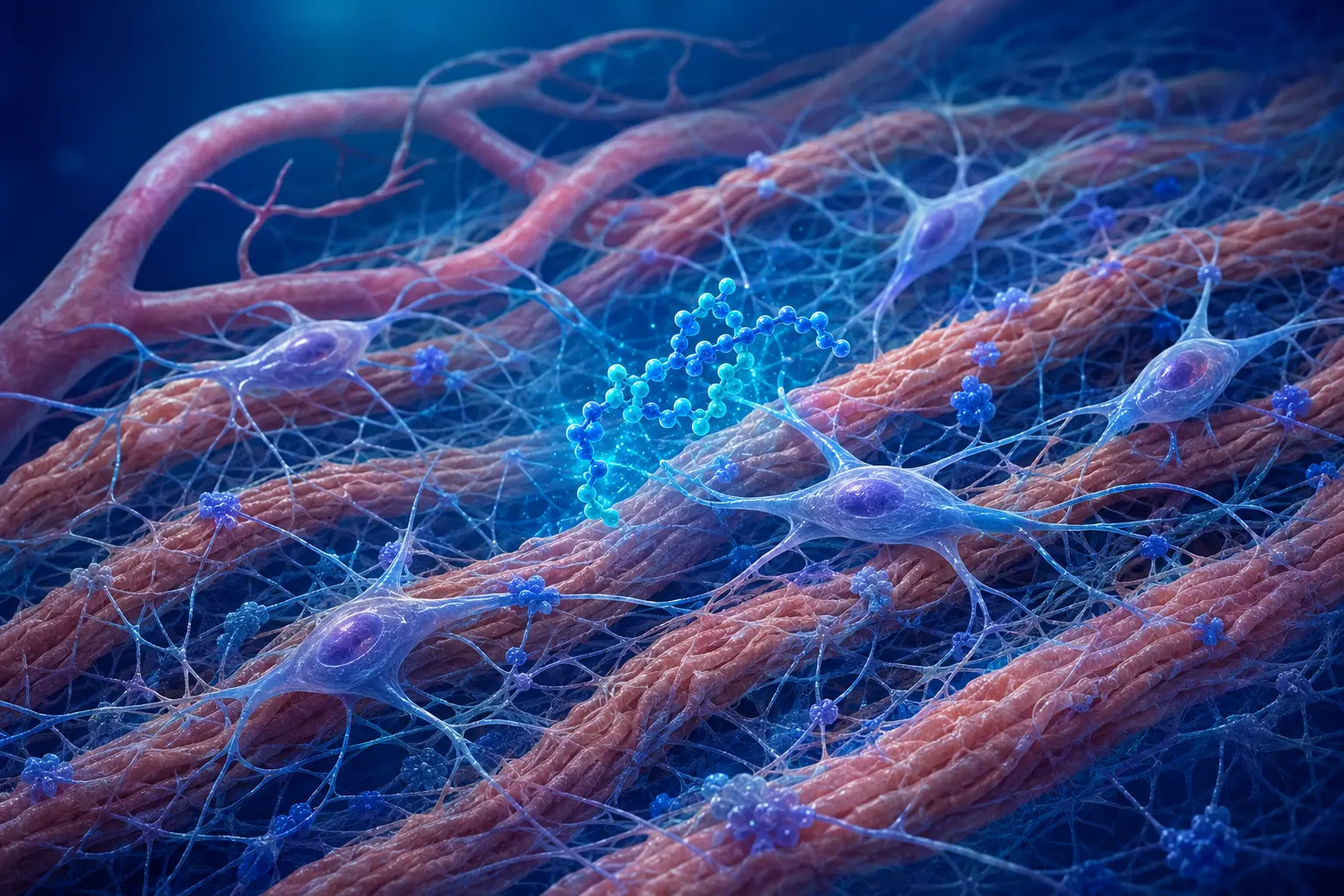
Tissue repair is one of the most studied applications in peptide research. Several compounds have been examined in animal models and early-stage human contexts for their potential roles in wound healing, connective tissue repair, angiogenesis, and anti-inflammatory signaling. This guide introduces the key compounds in this research area and the evidence behind each.
All compounds discussed are research-stage unless explicitly noted. None have received regulatory approval for the tissue repair applications discussed here.
What Tissue Repair Research Examines
Tissue repair is a multi-phase process involving hemostasis, inflammation, proliferation, and remodeling. Peptide researchers have focused primarily on the proliferation and remodeling phases, where mechanisms like angiogenesis, fibroblast migration, extracellular matrix synthesis, and growth factor signaling are active.
The research compounds in this cluster have been studied across multiple tissue types — skin, tendon, muscle, gut, and connective tissue — often in rodent injury models.
BPC-157
BPC-157 (Body Protection Compound-157) is the most extensively studied peptide in this cluster. It is a synthetic 15-amino acid sequence derived from a protein in human gastric juice. In rodent models of tissue injury, BPC-157 has been studied for:
- Accelerated healing across skin, tendon, muscle, and gut tissue
- Nitric oxide pathway modulation relevant to vascular repair
- VEGF-mediated angiogenesis in wound tissue
- FAK (focal adhesion kinase) pathway effects on cell migration
A 2019 review by Gwyer et al. summarized BPC-157's role in musculoskeletal soft tissue healing, noting accelerated repair outcomes across multiple animal models [1]. The research base is extensive but primarily preclinical — no large controlled human trials have been published.
TB-500 (Thymosin Beta-4)
TB-500 refers to a synthetic fragment of Thymosin Beta-4 (Tβ4), a ubiquitous intracellular peptide involved in actin regulation. Its research profile emphasizes cell migration and re-epithelialization — the processes by which wounds close.
A comprehensive review by Goldstein et al. outlined the multi-functional regenerative profile of Thymosin Beta-4, including roles in angiogenesis, anti-inflammatory signaling, and wound repair [2]. TB-500's parent molecule has advanced further toward clinical application than most compounds in this space — corneal wound healing trials with Tβ4 have included human data.
TB-500 complements BPC-157 mechanistically: while BPC-157 addresses vascular repair and inflammatory regulation, TB-500 drives keratinocyte and endothelial cell migration across wound surfaces.
GHK-Cu (Copper Peptide)
GHK-Cu contributes to this cluster through its role in extracellular matrix remodeling. Research has examined its effects on collagen synthesis, MMP/TIMP expression, and fibroblast activity — the structural repair layer that follows the vascular and cellular responses that BPC-157 and TB-500 address.
GHK-Cu bridges this cluster with the Skin Health & Longevity cluster, where it is the primary compound studied for dermatological applications.
The KLOW Stack
The KLOW Stack is a community-coined combination protocol adding KPV (Lys-Pro-Val), a tripeptide derived from alpha-MSH, to the GHK-Cu + BPC-157 + TB-500 base. KPV has been studied in gut inflammation models for anti-inflammatory effects via MC1R receptor signaling and NF-κB inhibition.
The KLOW Stack is the broadest combination in this cluster, covering:
- Systemic anti-inflammation (KPV)
- Extracellular matrix repair (GHK-Cu)
- Vascular and connective tissue repair (BPC-157)
- Cell migration and re-epithelialization (TB-500)
No controlled combination trials have been published. The mechanistic rationale is based on complementary mechanisms of the individual components.
The Fundamentals Pillar
BPC-157 serves as the primary pillar article for this cluster — it contains the most detailed mechanistic review and the broadest research coverage across tissue types. Start there for in-depth analysis.
Research Considerations
- Preclinical-dominant evidence: Most findings come from rodent models. Translational validity to human tissue repair is not established.
- Single research group for BPC-157: The majority of BPC-157 published work comes from the University of Zagreb. Independent replication is limited.
- No combination study data: Stack protocols like KLOW are mechanistically motivated but have no controlled combination research.
- Route and dose uncertainty: Animal dosing does not translate directly to human protocols, and pharmacokinetic data in humans is minimal.
For a deeper evaluation framework, see Evaluating Peptide Research Claims and Understanding Clinical Trials for Peptide Drugs.
References
- 1.Gwyer D, Wragg NM, Wilson SL. “Gastric pentadecapeptide body protection compound BPC 157 and its role in accelerating musculoskeletal soft tissue healing.” Cell and Tissue Research. 2019;377(2):153-159. doi:10.1007/s00441-019-03016-8 [PubMed]
- 2.Goldstein AL, Hannappel E, Sosne G, Kleinman HK. “Thymosin β4: a multi-functional regenerative peptide. Basic properties and clinical applications.” Expert Opinion on Biological Therapy. 2012;12(1):37-51. doi:10.1517/14712598.2012.634793 [PubMed]