Skin Health and Longevity Research: A Guide to the Peptides Studied for Regeneration
An introduction to the peptides most studied for skin repair, anti-aging, and cellular longevity — covering GHK-Cu, collagen peptides, Epithalon, and the Glow Stack.
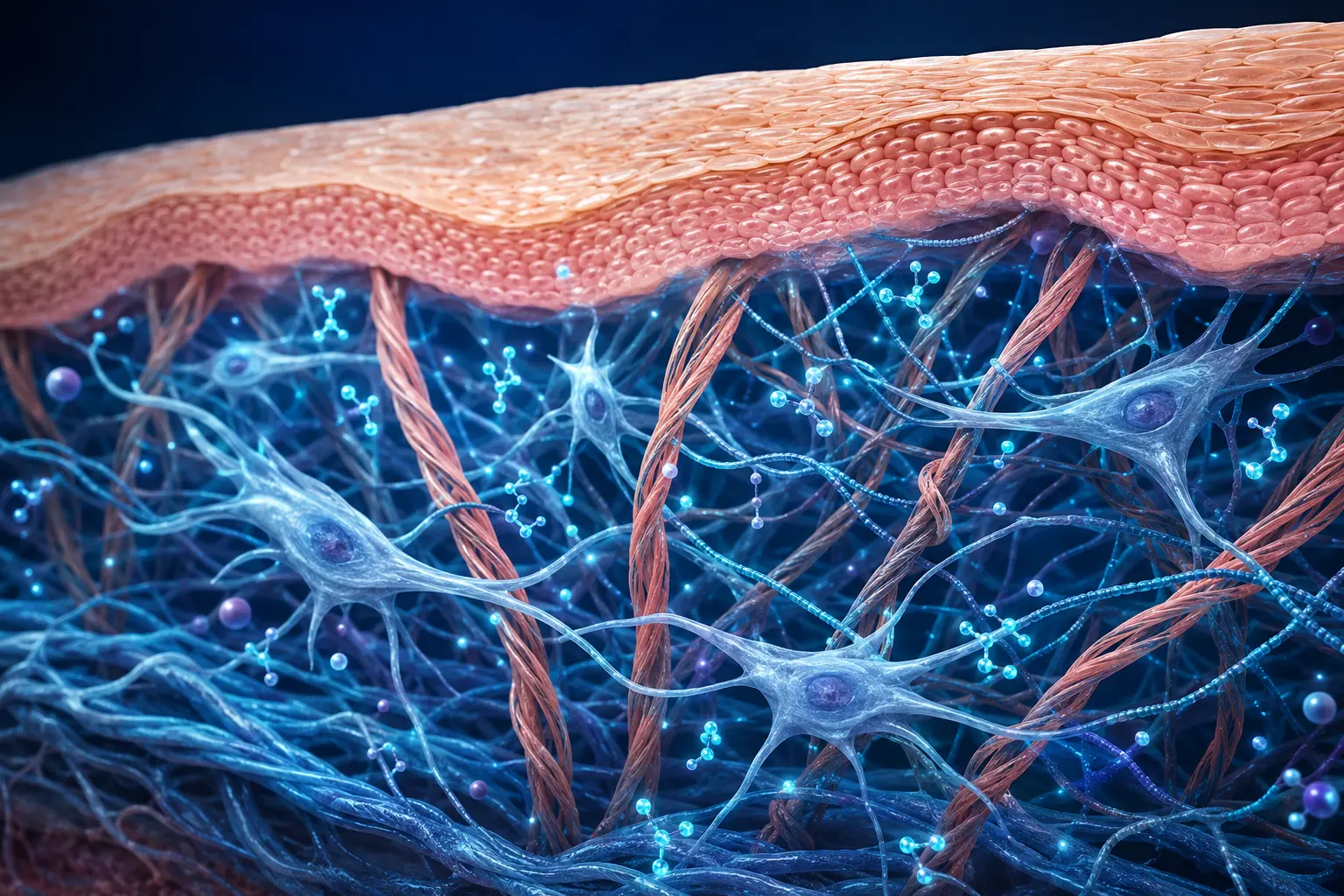
Skin aging and cellular longevity are active areas of peptide research. Several naturally occurring and synthetic peptides have been studied for their roles in extracellular matrix repair, collagen synthesis, antioxidant signaling, and telomere biology. This guide introduces the compounds most commonly examined in this research area and the evidence base behind each.
This is not a clinical recommendations page. All compounds discussed are research-stage unless explicitly noted.
What Skin Aging Research Examines
Skin aging involves multiple biological processes: declining collagen production, degradation of the extracellular matrix (ECM), increased oxidative stress, reduced cellular turnover, and changes in vascular supply. Peptide researchers have focused on compounds that may address one or more of these processes at the molecular level.
The evidence base varies considerably across this class. Some compounds — particularly collagen peptides — have been examined in controlled human trials. Others, like GHK-Cu and Epithalon, have more extensive in vitro and animal research than human clinical data.
GHK-Cu (Copper Peptide)
GHK-Cu is a naturally occurring tripeptide (glycine-histidine-lysine) that forms a complex with copper ions. It is found in human plasma, saliva, and urine, and its plasma concentration declines with age — a factor that has driven research interest.
Published research has examined GHK-Cu's role in:
- Stimulating collagen and glycosaminoglycan synthesis in fibroblast cultures
- Modulating matrix metalloproteinase (MMP) and TIMP expression relevant to ECM remodeling
- Anti-inflammatory signaling through NF-κB pathway inhibition
A 2018 genomics review by Pickart and Margolina analyzed GHK-Cu's effects on gene expression, finding associations with thousands of genes involved in tissue repair and regeneration [1]. The scope of this claim warrants careful evaluation — gene expression changes do not translate directly to clinical outcomes. Human skin trial data remains limited but exists in the dermatological literature.
Collagen Peptides
Collagen peptides are short-chain hydrolyzed fragments of collagen, typically derived from bovine or marine sources. Unlike the other compounds in this area, oral collagen peptides have been studied in randomized controlled trials examining skin hydration, elasticity, and wrinkle depth.
Controlled trial data — including a study by Shaw et al. examining vitamin C and gelatin (hydrolyzed collagen) supplementation — suggests that collagen-derived peptides can stimulate collagen synthesis in connective tissue [2]. The evidence quality for skin-specific outcomes is stronger here than for most other peptides in this cluster.
Epithalon
Epithalon is a synthetic tetrapeptide (Ala-Glu-Asp-Gly) studied primarily in the longevity and telomere biology literature. Most published research originates from Russian research groups examining its effects on telomerase activity and life extension in rodent models.
In vitro data suggests Epithalon may stimulate telomerase activity in human somatic cells. Animal research has reported effects on melatonin production and antioxidant status. The evidence base is significantly weaker than for collagen peptides or GHK-Cu — no large human randomized trials have been conducted.
FDA's July 2026 PCAC review evaluates epitalon-related bulk substances for a proposed insomnia use, not for longevity, anti-aging, or telomere effects. The FDA PCAC peptide review hub tracks the committee and FDA status.
The Glow Stack
The Glow Stack refers to a community-coined combination protocol combining GHK-Cu, BPC-157, and TB-500 — compounds studied for complementary mechanisms in skin and connective tissue repair. The name reflects the skin health focus of this particular combination.
Each component has individual research support, but the combination has not been studied in controlled trials. The mechanistic rationale (GHK-Cu for ECM remodeling, BPC-157 for vascular support, TB-500 for cell migration) is biologically plausible but unvalidated as a combined protocol.
Cross-Cluster Connections
The tissue repair mechanisms studied in this cluster overlap significantly with the research on BPC-157 and the Tissue Repair & Recovery cluster. GHK-Cu in particular bridges both areas — it has been studied for both dermatological applications and broader wound healing contexts.
For readers moving from overview material into more specific methods and evidence topics, Collagen Peptides: What the Research Examines is a useful next step, and How to Evaluate Peptide Research Claims: A Skeptic's Framework is a strong companion piece for assessing the strength of the claims in this area.
Research Considerations
When evaluating claims in this research area:
- In vitro ≠ in vivo: Most of the GHK-Cu gene expression data comes from cell culture experiments. Translation to human skin requires clinical trials.
- Single-group provenance: Much Epithalon research comes from one Russian research institute. Independent replication is limited.
- Cosmetic vs. pharmaceutical: GHK-Cu is widely used in cosmetic formulations at concentrations and via routes (topical) that differ significantly from the injectable research compound context.
- Combination protocols: Community stacks like the Glow Stack lack combination-study support. Individual compound evidence does not predict stack outcomes.
For a framework on evaluating the evidence quality of any peptide research claim, see Evaluating Peptide Research Claims.
References
- 1.Pickart L, Margolina A. “Regenerative and Protective Actions of the GHK-Cu Peptide in the Light of the New Gene Data.” International Journal of Molecular Sciences. 2018;19(7):1987. doi:10.3390/ijms19071987 [PubMed]
- 2.Shaw G, Lee-Barthel A, Ross ML, Wang B, Baar K. “Vitamin C-enriched gelatin supplementation before intermittent activity augments collagen synthesis.” American Journal of Clinical Nutrition. 2017;105(1):136-143. doi:10.3945/ajcn.116.138594 [PubMed]