Retatrutide vs Tirzepatide vs Semaglutide: Mechanisms, Trial Results, and Key Differences
How retatrutide, tirzepatide, and semaglutide differ in receptor targets, approval status, and Phase II/III weight-loss trial data — a side-by-side research comparison.
Quick Answer
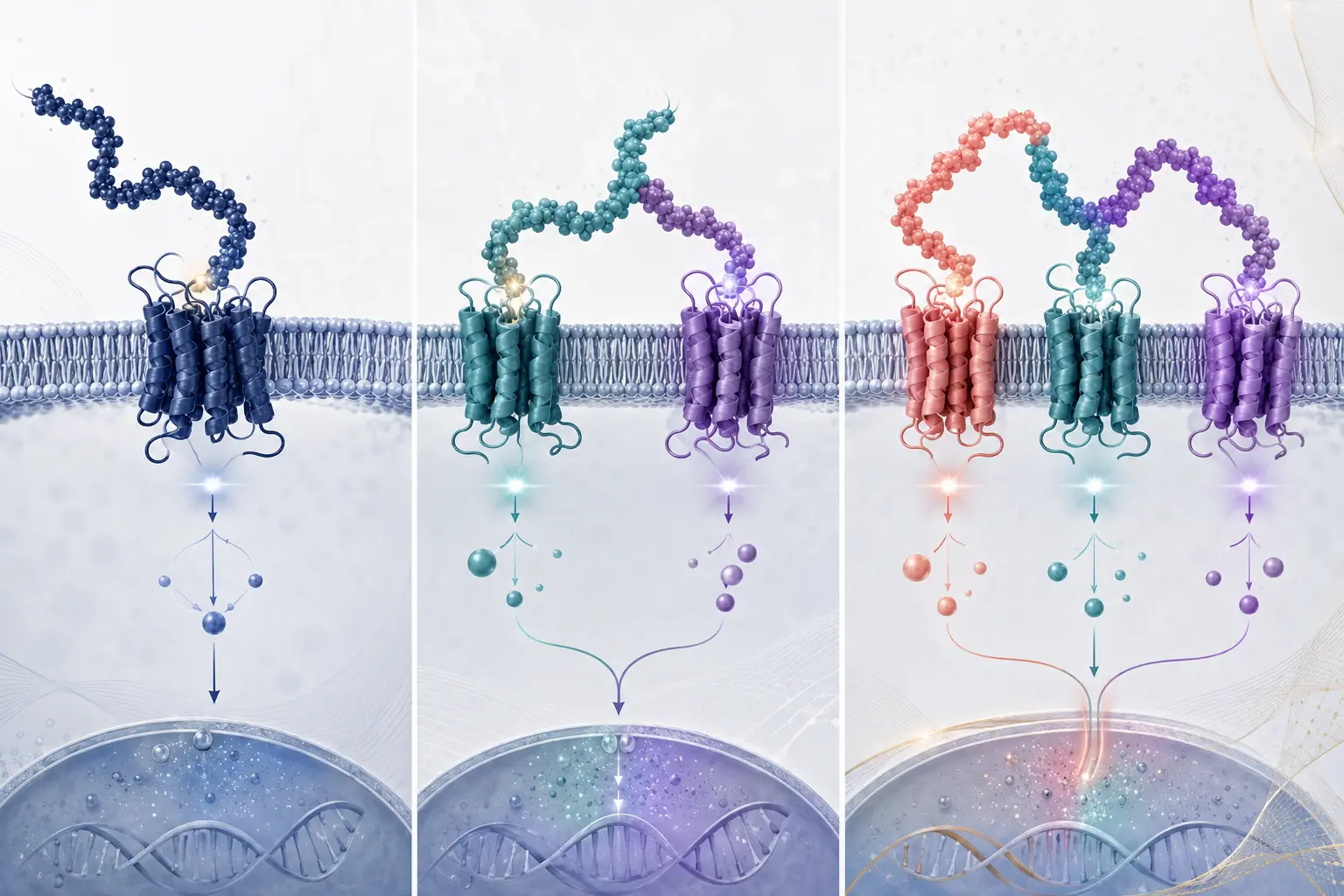
Retatrutide, tirzepatide, and semaglutide are all incretin-based peptides studied for obesity and type 2 diabetes, but they activate different combinations of receptors. Semaglutide activates only the GLP-1 receptor. Tirzepatide activates GLP-1 and GIP receptors ("dual agonist"). Retatrutide activates GLP-1, GIP, and glucagon receptors ("triple agonist"). Semaglutide and tirzepatide are FDA-approved; retatrutide is not — it remains in Phase III trials as of this writing, and its Phase II results should be interpreted with that limitation in mind.
Key Differences
| Semaglutide | Tirzepatide | Retatrutide | |
|---|---|---|---|
| Receptor targets | GLP-1R only | GLP-1R + GIPR | GLP-1R + GIPR + GCGR |
| Developer | Novo Nordisk | Eli Lilly | Eli Lilly |
| FDA approval | Yes (Ozempic, Wegovy, Rybelsus) | Yes (Mounjaro, Zepbound) | Not approved — Phase III |
| Highest-quality evidence | Phase III (SELECT, STEP) | Phase III (SURMOUNT, SURPASS) | Phase II (TRIUMPH-1) |
| Reported mean weight loss | ~14.9% (68 wk, STEP 1)[] | ~20.9% (72 wk, SURMOUNT-1)[] | ~24.2% (48 wk, TRIUMPH-1)[] |
| Cardiovascular outcome data | Yes (SELECT) | Not yet published | Not yet published |
Mechanisms and Receptor Targets
The three peptides sit on a spectrum of receptor complexity. Semaglutide is a single-target GLP-1 receptor agonist, structurally modified from native GLP-1 with an Aib substitution and a C18 fatty diacid chain for albumin binding. Tirzepatide adds GIP receptor activity on the same molecular backbone, engineered to bind both receptors with roughly balanced potency. Retatrutide goes further, adding glucagon receptor agonism — a target that classically raises blood glucose but may also increase energy expenditure and reduce hepatic fat when combined with GLP-1R/GIPR activity.
The rationale for adding receptor targets is that each additional pathway may contribute a partially independent mechanism toward weight loss: GLP-1R activation slows gastric emptying and suppresses appetite centrally; GIPR activation's role in weight regulation is still debated but appears to potentiate GLP-1R effects in this context; GCGR activation may increase resting energy expenditure. Whether these effects are additive, synergistic, or simply reflect higher effective dosing is not yet fully resolved in the literature.
Evidence Level Comparison
It is important not to compare these three compounds as if their evidence bases were equivalent. Semaglutide's obesity indication rests on multiple completed Phase III trials (STEP program) plus a dedicated cardiovascular outcomes trial (SELECT).[] Tirzepatide's evidence base includes the completed SURMOUNT (obesity) and SURPASS (diabetes) Phase III programs, including a head-to-head trial directly against semaglutide.[] Retatrutide's public evidence is presently limited to Phase II data from a single published trial.[] Phase II results frequently shift — sometimes substantially — once Phase III trials enroll larger, more diverse populations over longer durations, so retatrutide's reported ~24% weight loss figure should be treated as preliminary, not established.
Human Trial Results
Trial durations differ across the three compounds, which complicates direct numeric comparison. STEP 1 followed semaglutide 2.4mg for 68 weeks and reported average weight loss of approximately 14.9%.[] SURMOUNT-1 followed tirzepatide 15mg for 72 weeks and reported approximately 20.9%.[] TRIUMPH-1 followed retatrutide 12mg for only 48 weeks — a shorter observation window — and reported approximately 24.2%.[] A head-to-head SURPASS-2 trial directly compared tirzepatide against semaglutide in a type 2 diabetes population and found tirzepatide produced greater glycemic and weight benefits at the doses studied.[] No published head-to-head trial yet directly compares retatrutide against either tirzepatide or semaglutide.
Safety Findings
All three compounds share a class-wide gastrointestinal side-effect profile — nausea, vomiting, diarrhea, and constipation are the most commonly reported adverse events, generally most pronounced during dose escalation. Retatrutide's added glucagon receptor activity introduces a mechanism-specific consideration: glucagon receptor agonism could theoretically counteract glycemic control in some contexts, which is why Lilly's Phase II program studied separate obesity and type 2 diabetes cohorts to characterize this risk. Long-term safety data (multi-year exposure) is most mature for semaglutide, followed by tirzepatide, with the least real-world safety data available for retatrutide given its earlier stage of development.
Regulatory and Approval Status
Semaglutide holds FDA approval for type 2 diabetes (Ozempic, 2017), chronic weight management (Wegovy, 2021), and an oral formulation (Rybelsus, 2019). Tirzepatide holds FDA approval for type 2 diabetes (Mounjaro, 2022) and chronic weight management (Zepbound, 2023). Retatrutide has no FDA-approved indication and remains investigational, currently in Phase III trials. Readers should not interpret ongoing Phase III enrollment as an indication of eventual approval or of a particular timeline.
Research Limitations
Cross-trial comparisons of weight-loss percentages across different studies (rather than head-to-head randomized trials) are hypothesis-generating, not definitive — differing trial durations, entry criteria, and patient populations all affect the numbers. Readers evaluating these three compounds should weigh the maturity of the evidence base (Phase III with cardiovascular outcomes for semaglutide, Phase III for tirzepatide including a head-to-head trial, Phase II only for retatrutide) alongside the raw efficacy figures, rather than ranking the compounds purely by reported percentage weight loss. See Understanding Clinical Trials for Peptide Drugs for more on interpreting Phase II versus Phase III evidence.
References
- 1.Jastreboff AM, Kaplan LM, Frías JP, Wu Q, Du Y, Gurbuz S, Coskun T, Haupt A, Milicevic Z, Hartman ML; TRIUMPH-1 Phase 2 Investigators. “Triple-Hormone-Receptor Agonist Retatrutide for Obesity — A Phase 2 Trial.” New England Journal of Medicine. 2023;389(6):514-526. doi:10.1056/NEJMoa2301972 [PubMed]
- 2.Jastreboff AM, Aronne LJ, Ahmad NN, Wharton S, Connery L, Alves B, Kiyosue A, Zhang S, Liu B, Bunck MC, Stefanski A; SURMOUNT-1 Investigators. “Tirzepatide Once Weekly for the Treatment of Obesity.” New England Journal of Medicine. 2022;387(3):205-216. doi:10.1056/NEJMoa2206038 [PubMed]
- 3.Wilding JPH, Batterham RL, Calanna S, Davies M, Van Gaal LF, Lingvay I, McGowan BM, Rosenstock J, Tran MTD, Wadden TA, Wharton S, Yokote K, Zeuthen N, Kushner RF; STEP 1 Study Group. “Once-Weekly Semaglutide in Adults with Overweight or Obesity.” New England Journal of Medicine. 2021;384(11):989-1002. doi:10.1056/NEJMoa2032183 [PubMed]
- 4.Frias JP, Davies MJ, Rosenstock J, Perez Manghi FC, Fernandez Lando L, Bergman BK, Liu B, Cui X, Brown K; SURPASS-2 Investigators. “Tirzepatide versus Semaglutide Once Weekly in Patients with Type 2 Diabetes.” New England Journal of Medicine. 2021;385(6):503-515. doi:10.1056/NEJMoa2107519 [PubMed]