GLP-1, GIP, and Glucagon Receptors: How Incretin-Based Drugs Work
A mechanism-focused comparison of the GLP-1, GIP, and glucagon receptor pathways targeted by semaglutide, tirzepatide, and retatrutide, and why each receptor matters.
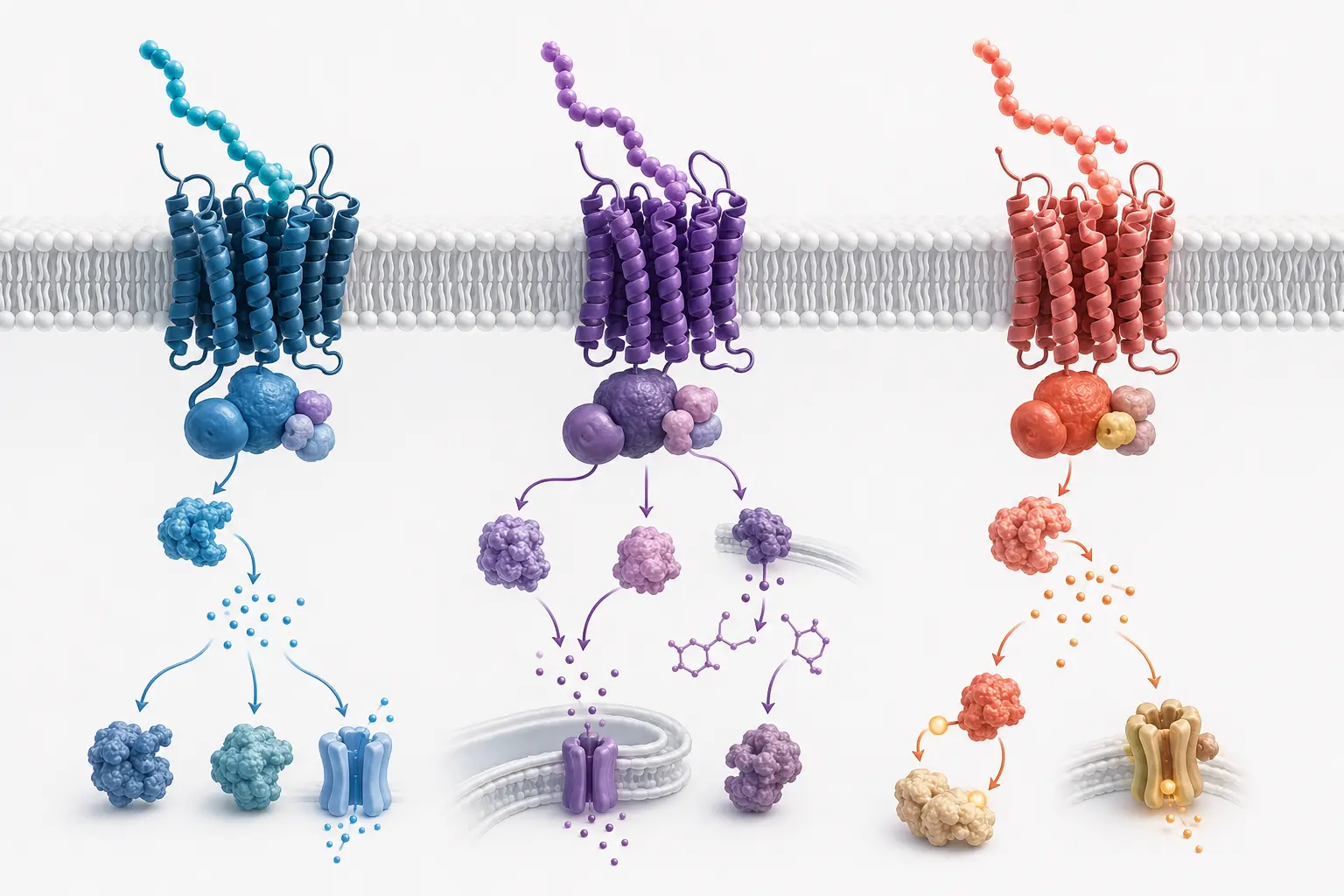
Semaglutide, tirzepatide, and retatrutide are frequently discussed side-by-side, but comparing them by drug name obscures the more fundamental research question: what does each receptor pathway actually do? This article looks at the mechanisms first, and the drugs second.
Quick Answer
Three G protein-coupled receptors are relevant to this drug class: the GLP-1 receptor (targeted by all three drugs), the GIP receptor (added in tirzepatide and retatrutide), and the glucagon receptor (added only in retatrudide). Each receptor contributes a partially distinct physiological effect, and understanding them separately explains why triple agonists like retatrutide were developed in the first place — see Retatrutide vs Tirzepatide vs Semaglutide for a drug-level comparison of trial outcomes.
Key Differences Between the Three Receptor Pathways
| Receptor | Primary classical role | Relevant drugs | Effect relevant to weight/glycemia |
|---|---|---|---|
| GLP-1R | Glucose-dependent insulin secretion, slows gastric emptying | Semaglutide, tirzepatide, retatrutide | Appetite suppression, glycemic control |
| GIPR | Glucose-dependent insulin secretion; historically linked to fat storage in lean rodents | Tirzepatide, retatrutide | Debated — may potentiate GLP-1R effects at pharmacologic doses |
| GCGR | Raises blood glucose via hepatic glycogenolysis; increases energy expenditure | Retatrutide only | Increased resting energy expenditure, reduced hepatic fat |
Mechanisms: GLP-1 Receptor Biology
GLP-1 (glucagon-like peptide-1) is secreted by intestinal L-cells in response to nutrient ingestion. Its receptor is expressed in pancreatic beta cells, the central nervous system, and the gastrointestinal tract.[] Activation potentiates glucose-dependent insulin release, suppresses glucagon secretion, slows gastric emptying, and signals satiety centrally. This is the foundational mechanism shared by semaglutide, tirzepatide, and retatrutide, and by the broader GLP-1 receptor agonist class.
Mechanisms: GIP Receptor Biology
GIP (glucose-dependent insulinotropic polypeptide) is the other major incretin hormone, secreted from K-cells in the proximal small intestine. Unlike GLP-1R activation, GIPR activation's role in weight regulation is genuinely debated in the literature — in some lean rodent models, GIPR agonism alone has been reported to increase fat storage, which historically made GIPR agonism seem like the wrong direction for weight-loss drug design.[] Combining GIPR activation with GLP-1R activation, as tirzepatide and retatrutide do, appears empirically to enhance efficacy relative to GLP-1R activation alone in human trials, though the precise mechanistic explanation for this remains an area of active investigation rather than settled science.
Mechanisms: Glucagon Receptor Biology
Glucagon is best known for raising blood glucose through hepatic glycogenolysis and gluconeogenesis — the opposite of what a diabetes or obesity drug typically aims to do. However, glucagon receptor activation has also been associated with increased energy expenditure, increased fat oxidation, and reduced hepatic steatosis in preclinical models.[] Retatrutide's developers added GCGR agonism specifically to capture this energy-expenditure effect, while relying on concurrent GLP-1R/GIPR activation to offset glucagon's glucose-raising tendency. This is the most mechanistically novel — and most studied only in Phase II — of the three pathways.
Evidence Level Comparison
GLP-1 receptor biology is the most extensively characterized of the three pathways, with decades of basic science and multiple completed Phase III drug trials.[] GIP receptor biology in the context of weight regulation is comparatively newer and more actively debated. Glucagon receptor agonism as an obesity-drug mechanism has the shortest track record, currently supported mainly by preclinical models and a single Phase II human trial.[]
Human Trial Relevance
Human trial data on the combined effect of these receptors is only available at the drug level — there is no published trial that isolates GIPR or GCGR contribution in isolation using retatrutide's exact combination in humans. The TRIUMPH-1 Phase II trial[] measured retatrutide's overall triple-agonist effect but was not designed to attribute weight loss to any single receptor's contribution.
Safety Findings
Each additional receptor pathway carries its own mechanism-specific safety consideration. GLP-1R and GIPR agonism share the class-wide gastrointestinal side-effect profile. GCGR agonism introduces a theoretical glycemic-elevation risk that is mechanistically distinct from the other two pathways, which is why triple-agonist trials have specifically studied both diabetic and non-diabetic cohorts.
Regulatory and Approval Status
No drug that activates GCGR for weight loss currently holds FDA approval; retatrutide remains in Phase III. Drugs targeting only GLP-1R or GLP-1R+GIPR (semaglutide, tirzepatide) are approved, reflecting the relative maturity of those mechanisms in human trials.
Research Limitations
Mechanistic explanations for receptor synergy in these drugs are often inferred from preclinical models and indirect trial comparisons rather than isolated within-drug dose-response studies of each receptor independently in humans. Readers should treat any claim that a specific receptor "causes" a specific percentage of weight loss with caution until dedicated human mechanistic studies are published.
References
- 1.Drucker DJ. “The biology of incretin hormones.” Cell Metabolism. 2006;3(3):153-165. doi:10.1016/j.cmet.2006.01.004 [PubMed]
- 2.Coskun T, Urva S, Roell WC, Qu H, Loghin C, Moyers JS, O'Farrell LS, Briere DA, Sloop KW, Haupt A, Milicevic Z, Perez-Tilve D, Tschop MH, Willard FS, Konkar AA. “LY3437943, a novel triple GIP, GLP-1 and glucagon receptor agonist for glycemic control and weight loss: From discovery to clinical proof of concept.” Cell Metabolism. 2022;34(9):1234-1247. doi:10.1016/j.cmet.2022.08.004 [PubMed]
- 3.Jastreboff AM, Kaplan LM, Frías JP, Wu Q, Du Y, Gurbuz S, Coskun T, Haupt A, Milicevic Z, Hartman ML; TRIUMPH-1 Phase 2 Investigators. “Triple-Hormone-Receptor Agonist Retatrutide for Obesity — A Phase 2 Trial.” New England Journal of Medicine. 2023;389(6):514-526. doi:10.1056/NEJMoa2301972 [PubMed]