GLP-1 Beyond Weight Loss: What Research Shows About Cardiovascular, Kidney, and Other Effects
A research overview of GLP-1 receptor agonist studies outside weight management, covering cardiovascular, kidney, liver, neurological, and reward-pathway research.
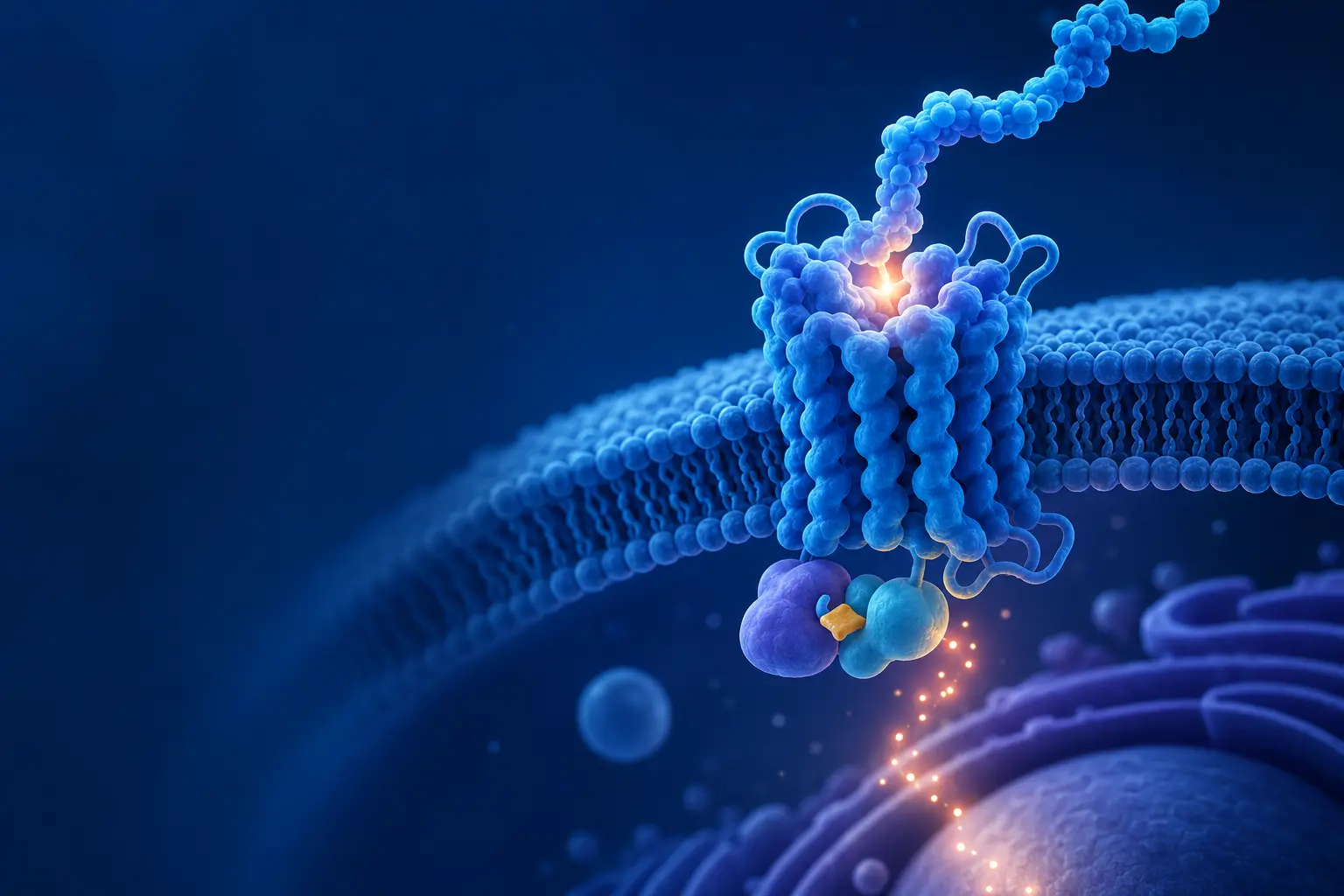
Most coverage of GLP-1 receptor agonists focuses on weight management, and for good reason — that's the effect that drove semaglutide and tirzepatide to widespread use, and that continues to shape research into newer multi-receptor agonists like retatrutide. But the GLP-1 receptor is expressed well beyond the tissues that regulate appetite, and researchers have spent the past decade investigating what that broader distribution might mean clinically. This overview summarizes where that research currently stands — and where it's still preliminary — across cardiovascular, kidney, liver, neurological, and reward-pathway domains.
This is a research summary, not a treatment guide. None of the studies described below should be read as evidence that any specific compound treats, cures, or prevents the conditions discussed; they are included because they illustrate the current state and limits of the research literature.
Why Researchers Look Beyond Weight Loss
GLP-1 receptors are not confined to the hypothalamus and gut. They have been identified in cardiac tissue, vascular endothelium, kidney, and regions of the central nervous system. This distribution is the biological rationale for investigating effects that are independent of, or only partially explained by, weight reduction — though separating a drug's direct receptor-mediated effects from the downstream consequences of weight loss itself remains a persistent challenge in this literature.
This distinction matters for how the research below should be read. A trial can report a real, statistically significant result while still leaving open the question of why the effect occurred — through direct receptor signaling in the affected organ, through weight loss, through improved glucose control, through reduced systemic inflammation, or some combination of these. Where researchers have specifically discussed this uncertainty, it's noted below.
Cardiovascular Research
The most extensively studied non-weight-loss application is cardiovascular risk reduction. Cardiovascular outcomes trials in people with type 2 diabetes suggested a benefit years before similar trials were run in people without diabetes.
The SELECT trial extended this question to a population with pre-existing cardiovascular disease and overweight or obesity but no diabetes. Over a mean follow-up of roughly 40 months, semaglutide was associated with a lower incidence of the composite endpoint of cardiovascular death, non-fatal myocardial infarction, or non-fatal stroke compared with placebo (Lincoff et al., 2023). This result is notable because it suggests a cardiovascular effect that isn't limited to people who already have diabetes, though researchers continue to debate how much of the benefit is attributable to weight loss versus direct vascular or anti-inflammatory mechanisms.
Kidney Research
Chronic kidney disease is common among people with type 2 diabetes, and GLP-1 receptor agonists have been studied as a potential way to slow its progression. The FLOW trial evaluated semaglutide in patients with type 2 diabetes and chronic kidney disease and found a lower risk of kidney-disease progression, kidney failure, or death from kidney or cardiovascular causes in the semaglutide group compared with placebo (Perkovic et al., 2024). Researchers have proposed several possible contributing mechanisms, including reduced inflammation and improved glucose control, but the relative contribution of each remains an open question.
Liver Research
Non-alcoholic steatohepatitis (NASH), now more commonly termed metabolic dysfunction-associated steatohepatitis (MASH), has also been an area of GLP-1 investigation. A placebo-controlled trial of subcutaneous semaglutide in patients with biopsy-confirmed NASH found that a higher proportion of patients receiving semaglutide had resolution of steatohepatitis without worsening of liver fibrosis, compared with placebo (Newsome et al., 2021). Fibrosis improvement itself was not statistically significant in that trial, which is an important distinction — the research suggests an effect on active liver inflammation more clearly than on established scarring.
Neurological Research
Preclinical work has long suggested that GLP-1 receptor agonists may have neuroprotective properties, prompting clinical investigation in neurodegenerative disease. A randomized, placebo-controlled trial of once-weekly exenatide in people with Parkinson's disease reported a difference favoring the exenatide group on a motor severity subscale after 48 weeks off-treatment, which the authors interpreted as consistent with a possible disease-modifying effect rather than a purely symptomatic one (Athauda et al., 2017). This was a single mid-sized trial, and the authors themselves were cautious about over-interpreting the result; larger phase 3 research in this area is ongoing, and findings should be treated as preliminary until replicated.
Reward Pathway and Addiction Research
A newer and smaller body of research has examined whether GLP-1 receptor agonists influence reward-related behavior, including alcohol consumption. A randomized, placebo-controlled trial of once-weekly exenatide in people with alcohol use disorder did not find a significant reduction in total alcohol intake for the full study group, but did report reduced heavy-drinking days in participants with obesity, along with reduced brain activity in reward-related regions when viewing alcohol cues (Klausen et al., 2022). This is an early and mixed signal rather than an established finding, and it illustrates why researchers treat GLP-1's effects on reward circuitry as hypothesis-generating at this stage rather than conclusive.
Interpreting This Research
A few patterns are worth keeping in mind when reading claims about GLP-1 effects beyond weight loss:
- Trial size and design vary widely. The cardiovascular and kidney trials involved tens of thousands of participants over years of follow-up; the neurological and reward-pathway research involves much smaller samples and shorter timelines.
- Weight loss is a confounder, not a control. Because most GLP-1 receptor agonists also produce weight loss, isolating a "direct" effect on the heart, kidney, or brain from an indirect effect of reduced body weight is methodologically difficult, and not every trial is designed to separate the two.
- Regulatory approval and research status are different things. Some of these findings (like the SELECT and FLOW results) have supported new regulatory indications; others (like the Parkinson's and alcohol-use-disorder research) remain investigational and have not led to approved uses for those conditions.
Researchers evaluating this literature should weigh trial size, replication status, and whether an effect has been confirmed in a dedicated outcomes trial before treating any single result as definitive.
References
- 1.Lincoff AM, Brown-Frandsen K, Colhoun HM, Deanfield J, Emerson SS, Esbjerg S, Hardt-Lindberg S, Hovingh GK, Kahn SE, Kushner RF, Lingvay I, Oral TK, Michelsen MM, Plutzky J, Tornøe CW, Ryan DH; SELECT Trial Investigators. “Semaglutide and Cardiovascular Outcomes in Obesity without Diabetes.” New England Journal of Medicine. 2023;389(24):2221-2232. doi:10.1056/NEJMoa2307563 [PubMed]
- 2.Perkovic V, Tuttle KR, Rossing P, Mahaffey KW, Mann JFE, Bakris G, Baeres FMM, Idorn T, Bosch-Traberg H, Lausvig NL, Pratley R; FLOW Trial Committees and Investigators. “Effects of Semaglutide on Chronic Kidney Disease in Patients with Type 2 Diabetes.” New England Journal of Medicine. 2024;391(2):109-121. doi:10.1056/NEJMoa2403347 [PubMed]
- 3.Newsome PN, Buchholtz K, Cusi K, Linder M, Okanoue T, Ratziu V, Sanyal AJ, Sejling AS, Harrison SA; NN9931-4296 Investigators. “A Placebo-Controlled Trial of Subcutaneous Semaglutide in Nonalcoholic Steatohepatitis.” New England Journal of Medicine. 2021;384(12):1113-1124. doi:10.1056/NEJMoa2028395 [PubMed]
- 4.Athauda D, Maclagan K, Skene SS, Bajwa-Joseph M, Letchford D, Chowdhury K, Hibbert S, Budnik N, Zampedri L, Dickson J, Li Y, Aviles-Olmos I, Warner TT, Limousin P, Lees AJ, Greig NH, Tebbs S, Foltynie T. “Exenatide once weekly versus placebo in Parkinson's disease: a randomised, double-blind, placebo-controlled trial.” The Lancet. 2017;390(10103):1664-1675. doi:10.1016/S0140-6736(17)31585-4 [PubMed]
- 5.Klausen MK, Jensen ME, Møller M, Le Dous N, Jensen AØ, Zeeman VA, Johannsen CF, Lee A, Thomsen GK, Macoveanu J, Fisher PM, Gillum MP, Jørgensen NR, Bergmann ML, Enghusen Poulsen H, Becker U, Holst JJ, Benveniste H, Volkow ND, Vollstädt-Klein S, Miskowiak KW, Ekstrøm CT, Knudsen GM, Vilsbøll T, Fink-Jensen A. “Exenatide once weekly for alcohol use disorder investigated in a randomized, placebo-controlled clinical trial.” JCI Insight. 2022;7(19):e159863. doi:10.1172/jci.insight.159863 [PubMed]