KPV Peptide Research: Mechanisms, Evidence, Safety, and FDA Status
A source-driven review of KPV, the Lys-Pro-Val fragment of alpha-MSH, including inflammation models, human evidence gaps, safety, and FDA status.
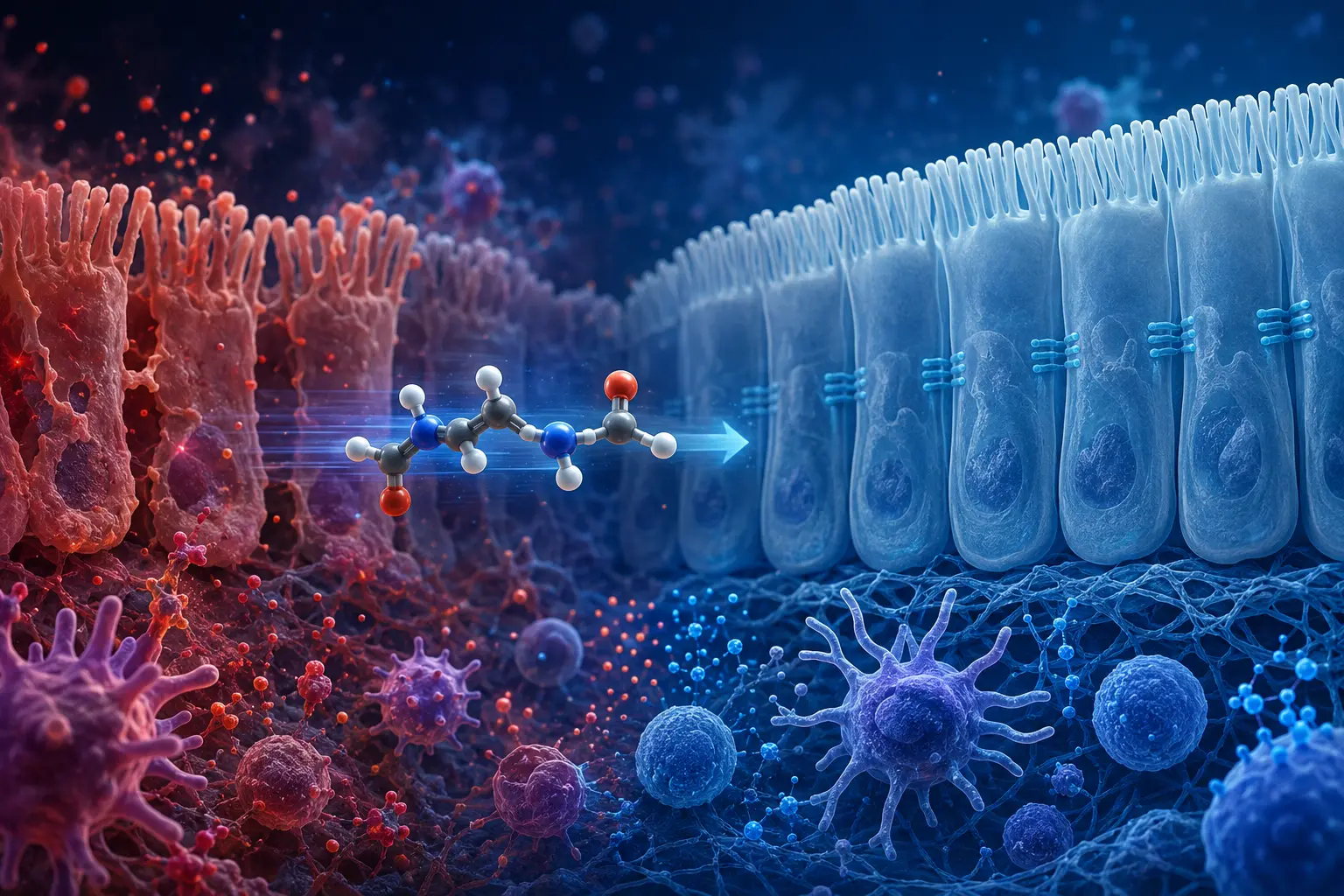
KPV is a three-amino-acid peptide with the sequence Lys-Pro-Val. It corresponds to the C-terminal 11–13 fragment of alpha-melanocyte-stimulating hormone (alpha-MSH), a larger melanocortin peptide with signaling roles in pigmentation, inflammation, appetite, and other physiological processes.
Research interest in KPV centers mainly on anti-inflammatory signaling, intestinal inflammation models, and wound-related experiments. That interest should be kept in perspective: FDA's 2026 evaluation found no clinical studies in which KPV free base or KPV acetate was administered to humans. [1]
In This Article
- Origin and structure
- Proposed mechanisms
- Cell and animal evidence
- Human research
- Safety and side effects
- FDA and compounding status
- Frequently asked questions
Origin and Structure
KPV is not the complete alpha-MSH molecule. It is a short fragment consisting of lysine, proline, and valine. Fragment research asks whether a small region of a parent peptide retains selected biological activity without reproducing all effects of the full molecule.
The term “KPV” is also chemically incomplete unless the exact form is specified. FDA's July 2026 review distinguishes KPV free base from KPV acetate because the forms are different bulk drug substances. The agency also identified inconsistent naming and limited quality-control information in the nomination materials. [1]
Proposed Mechanisms
KPV has been studied as an inflammation-modulating fragment of alpha-MSH. Proposed mechanisms vary by model and are not fully resolved.
Intestinal peptide transport
One frequently cited study examined uptake through peptide transporter 1 (PepT1). In intestinal epithelial cells and mouse colitis models, researchers reported that PepT1 transported KPV and that exposure was associated with lower expression of several inflammatory mediators. [2] The work supports a transport-and-signaling hypothesis in the gut, but it did not test a compounded KPV product in human inflammatory bowel disease.
Melanocortin-related and non-melanocortin signaling
Research on alpha-MSH fragments suggests that KPV may reproduce some anti-inflammatory observations associated with the parent peptide. Some experiments have examined melanocortin receptors, while others suggest effects can occur through pathways not fully explained by classical receptor binding. [3][4]
NF-kappaB and cytokine signaling
Cell studies have evaluated inflammatory transcription factors and mediators such as NF-kappaB, nitric oxide, and cytokines. Reported changes are mechanistically interesting, but they remain in vitro observations unless confirmed in living systems and eventually in controlled human trials.
Cell and Animal Evidence
The strongest KPV evidence is preclinical. Studies include cultured immune or epithelial cells, chemically induced colitis models in mice, corneal wound models, and delivery experiments.
In the intestinal research, KPV was associated with reduced inflammatory markers and improved measures in mouse colitis models. [2] Other alpha-MSH fragment work reported anti-inflammatory activity in experimental systems. [3] These studies help define hypotheses about mechanism; they do not establish treatment effectiveness for ulcerative colitis, Crohn's disease, eczema, psoriasis, or wound healing in people.
Delivery research adds another limitation. A 2017 study measured movement of KPV across microporated human cadaver skin using iontophoresis. [5] That is a formulation and permeability experiment—not evidence that KPV improves a clinical skin condition.
Human Research
FDA searched PubMed, Embase, ClinicalTrials.gov, and other sources for its 2026 briefing. The agency reported that it did not identify clinical studies or human exposure data for KPV free base or KPV acetate by any route. [1]
This means there is no established human evidence base for:
- Clinical effectiveness
- Pharmacokinetics or bioavailability
- Dose-response relationships
- Short- or long-term adverse-event rates
- Immunogenicity
- Comparative effectiveness against approved therapies
Human-derived cells and cadaver skin are sometimes described online as “human research,” but they are not clinical exposure studies.
Safety and Side Effects
No well-characterized side-effect profile exists because controlled human exposure data are absent. FDA's searches did not identify human case reports, clinical safety studies, or pharmacokinetic studies for the reviewed KPV forms. [1]
That absence should not be interpreted as proof of safety. FDA highlighted unknown risks related to product identity, impurities, aggregates, microbiological controls, and potential immune responses. Risks may also depend on formulation and route.
Online lists of KPV side effects often repeat anecdotal reports without defining the chemical form, purity, co-administered substances, or causal relationship. Such reports may generate hypotheses but cannot establish incidence or causation.
FDA and Compounding Status
KPV is not an FDA-approved drug. FDA evaluated KPV free base and KPV acetate for the 503A Bulks List in connection with proposed use for wound healing and inflammatory conditions.
In its briefing document, FDA concluded that the balance of physical and chemical characterization, historical use, effectiveness evidence, and safety information weighed against listing both forms. FDA staff proposed that neither be added. [1]
On July 23, 2026, PCAC voted 8–6, with one abstention, to recommend inclusion of the KPV-related group. The recommendation is nonbinding and does not establish that KPV is safe, effective, or FDA approved. FDA final action on the 503A Bulks List remains pending. [6]
See the FDA PCAC review hub for the full meeting outcome and next steps.
Evidence Assessment
| Evidence area | Current assessment |
|---|---|
| Molecular rationale | Plausible but not fully resolved |
| Cell studies | Multiple inflammatory models |
| Animal studies | Includes colitis and wound-related models |
| Human administration studies | None identified by FDA |
| Clinical effectiveness | Not established |
| Long-term safety | Unknown |
| FDA approval | Not approved |
KPV therefore fits an early research category: meaningful preclinical signals with major translational and safety gaps. It should not be treated as a clinically validated anti-inflammatory therapy.
Frequently Asked Questions
Is KPV the same as alpha-MSH?
No. KPV is the Lys-Pro-Val C-terminal fragment of alpha-MSH. A fragment may retain selected activity, but it is not biologically identical to the full parent peptide.
Has KPV been tested in humans?
FDA reported that it did not identify clinical administration or human exposure data for KPV free base or KPV acetate. Laboratory work using human cells or cadaver skin does not answer clinical safety or effectiveness questions.
Is KPV FDA approved?
No. KPV is not an FDA-approved drug. Its July 2026 PCAC review concerns the 503A Bulks List, which is separate from drug approval.
Does KPV treat inflammatory bowel disease?
Cell and mouse research has examined intestinal inflammation, but controlled human trials have not established that KPV treats inflammatory bowel disease.
How does KPV compare with BPC-157 or TB-500?
They are different peptides with different proposed mechanisms and evidence bases. KPV is derived from alpha-MSH; BPC-157 is a 15-amino-acid synthetic peptide studied mainly in animal models; TB-500 is a thymosin beta-4 fragment discussed in actin and wound research.
References
- 1.U.S. Food and Drug Administration. “FDA Briefing Document for KPV-Related Bulk Drug Substances.” 2026. [Link]
- 2.Dalmasso G, Charrier-Hisamuddin L, Nguyen HTT, Yan Y, Sitaraman S, Merlin D. “PepT1-mediated tripeptide KPV uptake reduces intestinal inflammation.” Gastroenterology. 2008;134(1):166-178. doi:10.1053/j.gastro.2007.10.026 [PubMed]
- 3.Getting SJ, Schiöth HB, Perretti M. “Dissection of the anti-inflammatory effect of the core and C-terminal (KPV) alpha-melanocyte-stimulating hormone peptides.” Journal of Pharmacology and Experimental Therapeutics. 2003;306(2):631-637
- 4.Brzoska T, Luger TA, Maaser C, Abels C, Böhm M. “Alpha-melanocyte-stimulating hormone and related tripeptides: biochemistry, antiinflammatory and protective effects in vitro and in vivo.” Endocrine Reviews. 2008;29(5):581-602
- 5.Pawar K, Kolli CS, Rangari VK, Babu RJ. “Transdermal iontophoretic delivery of Lysine-Proline-Valine (KPV) peptide across microporated human skin.” Journal of Pharmaceutical Sciences. 2017;106(7):1814-1820
- 6.Eglovitch JS. “FDA advisory committee backs two more peptides, rejects one for compounding list.” Regulatory Focus, Regulatory Affairs Professionals Society. 2026. [Link]